
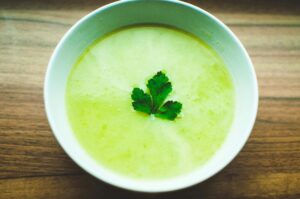
 This recipe is an adaptation of one I first made about 30 years ago (in my vegan days) from The American Vegetarian Cookbook from the Fit for Life Kitchen by Marilyn Diamond. Better hot but also good cold IMO!
There have been many incarnations of this soup in my life, including as a staple at the health food deli where I worked–along with a catering job–to finance an 8-week trip to an ashram in India (that, my friends, is a story for another time.)
Lately I’ve simplified the soup to the bare bones for a quick and delicious low allergen side dish. Sometimes I have this with a side of tempeh, sometimes chicken, and it’s a really great side with salmon.
(more…)

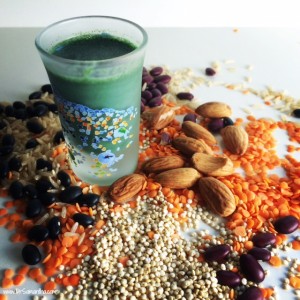 I was at the gym the other day chatting with a friend about eating protein to build muscle. He mentioned that he likes to eat rice and beans after lifting since it’s a “perfect protein.” I have another friend who is a savvy recipe developer and chef who posted on facebook that she was very excited that she finally found a doctor who told her to focus on plant based proteins for optimal health. A third friend, a very well known health educator and coach posted that she sucked down a thick slurry of spirulina mixed with water every morning and gave it a hashtag #veganprotein.
It’s true that all of these are good quality proteins, not to mention imho, delish, but if you’re trying to increase your protein intake significantly, and you’re not actually vegan, plant based proteins are not your best bet (please note my caveat that if you’re an ethical vegan and trying to avoid or not overdo soy and wheat gluten, these are your best bet!)
Here’s the catch. Plant-based proteins are almost always higher in either carbs or fat than protein, and often by leaps and bounds. Additionally, most of us pair these proteins with carbs by rote, and suddenly our attempt at higher protein turns into, well, not so much higher protein.
I wanted to work up a detailed breakdown for you to so you can figure out exactly how to eat them to greatest benefit. If you do eat meat and/or dairy, one of the best ways to make use of plant-based proteins is to combine them with high quality animal proteins (or whey or pea protein powder). Almond butter gravy for turkey, mixing beans and grass fed/finished beef for chili, spirulina added to your protein smoothie, etc.
Here are a few of the things my patients will ask me about as plant-based protein options with their actual nutritional breakdown included.
Nut butter and Nuts.
Nuts are generally a very healthy food for most people. Easier to digest if soaked, they have good fatty acids (best raw and ALWAYS keep them in the fridge or freezer or they’ll go rancid before you can shake a stick at them) and lots of fiber. They are not, however, a concentrated protein. Here is the breakdown for almonds and almond butter as an example.
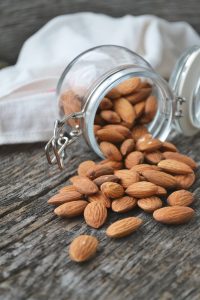 Almonds ¼ cup
Carbohydrates 7g: Protein 8g: Fat 18g: Fiber 5g
Now add some almond butter to a piece of toast, let’s say whole grain toast, and here’s the profile for 2 slices- again, note the total number of carbs vs protein:
Almond butter 2 TBSP, 2 slice whole wheat toast
Carbohydrates 34g: Protein 14g: Fat 20g: Fiber 8g
Quinoa.
I love this grain. Mostly because it’s not a grain, it’s a seed. High in fiber and high in protein for a grain because, well, it’s a seed, not a grain. Still not a concentrated protein in any way. That said, if you are trying to increase your protein, having quinoa instead of rice or quinoa chips (yum) instead of potato chips is a fabulous call.
Quinoa 1 cup
Carbohydrates 39g: Protein 8g: Fat 4g: Fiber 5g
 Spirulina.
 Spirulina.
This superfood is nutrient rich and is indeed high in protein compared to other nutrients. But one tsp has a mere 2 g of protein. To get the equivalent of, say, 2 eggs, you’d need 6 tsp of spirulina, hardly a reasonable breakfast choice (challenge: if you come up with a recipe that’s edible I’ll post it on the blog with attribution, of course!)
Beans.
Beans are mostly carbohydrate, some protein and a little bit of fat- lots of fiber which is great but people often think they’re grabbing protein when they add beans to a meal. Here’s the breakdown for black beans.
Black Beans 1 cup
Carbohydrates 45g: Protein 15g: Fat 1g: Fiber 15g
 Beans and rice.
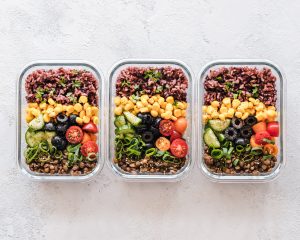 Beans and rice.
Of all of the questions about good plant-based proteins this is probably the most common. As a vegan for years (I even briefly ran and owned a vegan restaurant with my ex-husband) I used beans and rice as a source of protein almost daily. I personally need a diet with more protein than that. When I was eating beans and rice several times a day I wasn’t getting what I needed- I was tired and overweight no matter how much exercise I did.
Here’s the deal, beans and rice are a complete protein when you eat them together. This means that between them they contain all of the building blocks necessary to build proteins in your body. Meat and other animal products as well as quinoa contain everything you need on their own. And, if you eat animal products at all you already have all of the amino acids you need to build those proteins so don’t need to worry about combining them. Oh, and no, they don’t have to be eaten in the same meal to make a complete protein, just within about 24 hours, even if you are vegan as your body will store what it needs. But (back to the point here) when you combine beans and rice you end up with a very high carbohydrate meal.
Take the black beans above and pair it with a cup of brown rice and look at the breakdown!
Carbohydrates 91g: Protein 20g: Fat 2 g: Fiber 19g
All healthy food but far from high protein. Consider that this combo is often also wrapped in a tortilla and dubbed “vegetarian burrito” and that pushes the carbs up another 20g and the protein up only a few grams if that.
The take home.
If you eat grains and beans these are good choices. But, if you’re trying to get your protein up significantly, these plant based proteins aren’t going to do it. Of course if you’re vegan for ethical reasons plant based protein sources are your only choice. It’s doable to get higher levels of protein, just not easy. Here is a post about how much protein people typically need (minimum and ideal), and who might need more, or less. Feel free to reach out if you have questions!
Yours in Health,


Although asparagus isn’t my personal jam (TMI alert: I can’t stand when it makes my pee smell!!) I know that people love it. And, it’s a great food for spring according to Chinese Medicine. Here’s why:
Living in tune with the cycles of the seasons is a lifestyle recommendation made in Chinese Medicine to help achieve a state of balance and health. In addition to regular acupuncture treatments, one of the best ways this can be achieved on a daily basis is through diet. Eating what is fresh and in local abundance during the various seasons not only tastes better but is healthier too.
The appearance of asparagus in plentiful supply always signals to me that spring has fully arrived. Asparagus is full of vitamin A, vitamin C, vitamin K, folate and fiber. Asparagus also contains the amino acid asparagine, a natural diuretic which can help with conditions such as hypertension and atherosclerosis.
According to Chinese Medicine, asparagus builds the yin or nourishing fluids in the body. This means that asparagus, from a Chinese Medical perspective can help sooth irritation, improve reproductive health, and encourage fertility. Asparagus also promotes healthy lungs in Chinese Medicine. Its moistening nature is thought to help with conditions such as lung congestion, chronic bronchitis, and tuberculosis.
In addition, since this recipe is full of garlic and cilantro it helps to “detoxify the body” which is perfect for the natural desire to cleanse in the spring.
Ingredients (serves 4-6)
Salad
- 1 cup quinoa, rinsed and drained
- 1 cup fresh snap peas, strings removed and cut into bite size diagonals
- 1 bunch asparagus, snap off the fibrous ends and cut into ½ inch diagonals
- 1 can chickpeas, drained and rinsed
- Fresh mixed greens
- Sliced avocado
Dressing
- Juice of 1 lemon
- 1/3 cup olive oil
- Salt and Pepper to taste
- 2-3 cloves minced garlic
- 1/3 cup chopped cilantro
What to Do

- Rinse the quinoa in a fine mesh strainer to remove any bitter taste. Combine 1 cup quinoa with 2 cups of water in a sauce pan, cover and bring to a boil over medium- high heat. Simmer for 15-20 minutes, until all the water is absorbed, turn off heat and fluff with a fork.
- Blanch the asparagus. Bring a pot of water to a boil and add the cut and prepared asparagus. Cook the asparagus in the boiling water for 1-2 minutes until just tender. Quickly drain in a colander and rinse with cold water.
- Transfer cooked quinoa into a large mixing bowl and stir in the lemon juice, olive oil, salt and pepper. Add garlic and cilantro. Mix in the snap peas, asparagus, and chickpeas. Adjust to taste and serve over lettuce and topped with sliced avocado.
Enjoy!

 A few weeks ago a spate of posts hit social media in response to a study result that “proved” that non-celiac gluten sensitivity doesn’t exist.
My first response was to roll my eyes and ignore it as I do with most viral sensationalist headlines. But then I started getting emails, and tweets, and even a few phone calls. So I spent some time reading the posts, which were showing up on all kinds of mass media sites. And then, of course, I went to the original study.
[Spoiler, although the study is great food for thought, it does not come anywhere near proving that NCGS doesn’t exist- a point that the author of the study makes repeatedly.]
Here’s the scoop.
Researcher Peter Gibson did a study in 2011 with 34 subjects with IBS (irritable bowel syndrome) who self-reported to be symptomatically managed when off of gluten.
The subjects continued their existing gluten-free diets in the study but were then given 2 slices of bread and one muffin a day that were either with or without gluten. The result showed that yes, there was a statistically significant difference in symptoms in those who had the gluten added back into their diets. The conclusion of the study was “’Non-celiac gluten intolerance’ may exist, but no clues to the mechanism were elucidated.”
This researcher had some doubts about this result. Or at least he wanted to try to dig deeper. I’m always a fan of digging deeper. And in his defense, I’m not sure he meant for this to wind up a shit storm of shaming of people who have the experience of feeling better when they don’t eat gluten.
So he did another study that was published in Dec 2013. It hit the internet like a tornado in May of 2014.
In this study subjects were put on a FODMAP free diet. FODMAP is an acronym for “Fermentable, Oligo-, Di-, Mono-saccharides And Polyols.” It has been shown in studies that avoiding these foods, which include wheat and rye (but not barley), and a long list of other fruits, vegetables and some legumes, IBS symptoms can improve dramatically as some people seem to lack the ability to properly digest these foods. It’s a long list of foods and not an easy road, avoiding them. That said, this is more likely to have an underlying cause impacting ability to digest that can be helped when we treat the gut. The results of the study showed that it was the FODMAPs that caused a problem for the subjects who thought they had a gluten sensitivity.
And…the internet went nuts.
Apparently, nothing makes people aggressive and irritable more than hearing that someone else is avoiding foods because it makes them feel better (seriously, what’s up with that?). Even large media outlets like Forbes had headlines such as “Gluten Intolerance May Not Exist.” (Really, Forbes?) The agro, up in everyone’s food-business crowd was in heaven with the headlines proclaiming that those people who ask for no gluten were MAKING IT ALL UP, I mean, a study just came out proving that.
But wait. That’s not what the studies are saying at all.
The studies are saying that people in this sample were more likely to be sensitive to FODMAP foods than gluten itself. They self-selected as feeling better off of gluten most likely because by eliminating gluten-containing foods (wheat and rye) they decreased their FODMAP burden. So although it isn’t then non-celiac gluten sensitivity, it’s non-celiac wheat/FODMAP sensitivity. And it’s just as much a sensitivity to wheat and rye (barley is lower in FODMAPs) as is non-celiac gluten sensitivity.
But there’s more.
Probably more important is that this study only looked at the effects of gluten in a very small subgroup of people with a specific diagnosis, IBS.
Many of us experience severe symptoms from gluten that have nothing to do with our intestinal tract. I experience anxiety and mood swings as well as severe fatigue when I eat foods containing gluten. I have patients and clients with only neurological symptoms when they eat foods containing gluten. I have patients and clients with only concentration or attention issues when they eat foods containing gluten. Same for migraines, chronic headaches, joint pain, rashes, and more.
Could it be that some of these people are responding to FODMAPs? Sure. Could it be that there is something else that is impacting symptoms that resolves when gluten is removed? Sure.
Do I care? Well, yes, because the more we understand the better we will be able to mitigate symptoms for patients. But the bottom line is that this study does absolutely nothing to tell us that there is no such thing as gluten sensitivity. This study shows us that physicians should also be trying a low FODMAP diet with our IBS patients.
Though…if cutting out only gluten lowers that person’s exposure to FODMAPs enough to make them symptoms free, do we really need to also cut out the list of 50 or so other fruits, vegetables, grains, and legumes? That’s going to be another post, I’m afraid.
Yours in Health,
 If you’re tired of feeling worn-out, frazzled and not yourself. You know exactly what you want more of: energy. You want the fuel to pursue your passions, chase your kids, and get ahead at work. You want to wake in the morning feeling well-rested and go to bed at night feeling like the day has been well-spent. You want to feel great
Being gluten-free is often a big step toward feeling better on a daily basis whether it is a necessity or a choice. Your digestion is better, your overall health is better, your mood may even be better. But you want more than that. You want to feel energetic, vital, and ready to face anything and everything that life has to throw your way.
Starting June 2nd I’ll be taking another group through my Gluten-Free Vitality class. It’s a 5 week VIRTUAL (as in all online) program where you get to the root of what’s making you tired.
People who stop merely treating the symptoms and address the root causes of their fatigue report more energy to do what they love, keep up with their families, and stay on top of work.
In this class we get to the root of your fatigue, we leave no rock unturned:
- Medical Causes: undiagnosed conditions, unmanaged disorders, conditions associated with celiac or non-celiac gluten sensitivity
- Nutritional Causes: too much processed food, vitamin deficiencies, food sensitivities
- Lifestyle Causes: lack of sleep, overloaded schedule, draining relationships
- Environmental Causes: exposure to chemicals and other harmful things around you

By the time summer is in full swing, you will feel re-energized about your health and you will have recharged your body’s ability to heal. You’ll have a better understanding of what you need for optimum vitality, so you can get back to pursuing your goals and enjoying life.
What would you do if you felt great this summer?
- Take that camping trip you’ve been putting off?
- Jump in the ocean?
- Play soccer with the kids?
- Plan (and enjoy!) a romantic getaway?
- Enjoy cooking healthy meals for family and friends?
- Go for long walks with friends?
I’ve watched my patients go from feeling sick and tired to planning their favorite activities and fully delighting in them by finally addressing the underlying causes of what’s making them feel less-than-great.
CLICK HERE FOR MORE INFORMATION!
I’m Dr. Samantha.

I’m a licensed Naturopathic physician with 18 years in my primary care Integrative medical practice in Portland, OR, and an advocate for living well.
Why is Gluten-free Vitality so important to me? Because it’s my story, and the story of so many of my patients.
I knew that feeling well, with more energy for doing the things I love, was possible and that’s what I wanted. I continued to dig into the underlying causes of my fatigue and varied symptoms until I found my sweet spot- the right balance of what I need to do to feel my best.
It is my mission to help you find that sweet spot too.
“She is exactly what I think a doctor should be: intelligent, extremely detail oriented, open minded about treatment methods, and focused on how all of my issues interact. I only wish I found her sooner!” — TD
CLICK HERE FOR MORE INFORMATION!
The lovely Ellen Goldsmith from Pearl Health invited me back for another interview at Health Currents Radio. Our last visit we spoke about gluten-free diets, and this time we spoke about stress. The night before the interview we hopped on the phone for a sec, which turned into half an hour discussing different aspects of what we can and can’t control in our lives and how that understanding can profoundly impact our health.
We continued our conversation at the studio about how stress is a part of life and if we have a better understanding of how it impacts us, and we take steps to change it, our lives change in the process. We discuss how the daily choices we make about what we eat, our exercise, and self-care impact our capacity to deal with and regulate the stress we experience. We take you through how stress affects you and present a manageable way of breaking it down to what you can control, what you cannot and what you can do for yourself.
If you haven’t seen it yet you can also sign up up here to get your FREE 15 minute video on the ins and outs of Stress 2.0.
Click on the arrow below to listen to our interview!
Enjoy!
Add more energy to your life every day.
Get 7 days of energy-infusing practices delivered to your inbox, FREE!
