
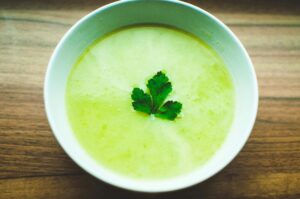
 This recipe is an adaptation of one I first made about 30 years ago (in my vegan days) from The American Vegetarian Cookbook from the Fit for Life Kitchen by Marilyn Diamond. Better hot but also good cold IMO!
There have been many incarnations of this soup in my life, including as a staple at the health food deli where I worked–along with a catering job–to finance an 8-week trip to an ashram in India (that, my friends, is a story for another time.)
Lately I’ve simplified the soup to the bare bones for a quick and delicious low allergen side dish. Sometimes I have this with a side of tempeh, sometimes chicken, and it’s a really great side with salmon.
(more…)


Following is an excerpt from my forthcoming book Overcoming Overwhelm: Dismantle Your Stress from the Inside Out. It’s available for pre-order at your favorite bookseller—you can find direct links here on my website!
If you don’t have the health you want, the energy you want, the peace of mind you want, the life you want, getting crystal clear about your core values is the first step to creating a road map to get there. Examining your ideas and beliefs and making choices in accordance with your values can help you get out from under your overwhelm and create the life you most want.
If you don’t examine your ideas and beliefs, there are a number of problems that may occur. First, you may end up living life by someone else’s rules, and you won’t choose the things that will lead you to where you really want to be in your life. Second, if there is a discrepancy between your core values and the choices you make on a day-to-day basis, it will have a profound impact on your mood, health, and energy and will add significantly to your overwhelm. This can apply to little things, like getting into bed on time, or big things, like marrying someone who looks good on paper but doesn’t really meet your heart’s desire.
And finally, making choices that are out of sync with your values creates a dissonance that your subconscious picks up on. This dissonance then leads to a sense of discomfort—anxiety, depression, general malaise—that can permeate well beyond any one decision and profoundly impact not only your state of mind, but also all aspects of your health and well-being. The stress of this dissonance, and the ensuing self-critical dialogue, can be so significant that it dwarfs the other stresses that are already overwhelming you day in and day out.
This dissonance can be so uncomfortable, in fact, that your subconscious will drive you to make choices to alleviate the discomfort—choices that make you produce dopamine (a hormone often called the “reward drug” because it mediates pleasure in your brain in the immediate moment), such as overeating, eating sugar, having a drink, shopping, or whatever your vice of choice may be. And even though indulging in one of these activities feels good in the moment, it ultimately pushes you further away from a life of less overwhelm and greater ease.
I’m not saying that making choices in alignment with your values will cure all ill health or will mean you’ll never feel overwhelmed. Nor am I saying that we don’t sometimes need to compromise. But understanding what your values are is the foundation for understanding what you can and can’t let go of, what you can and can’t control, and what you can and can’t do to live a life aligned with what means most to you. The key is to keep your finger on the pulse of your life and to be aware at any given moment of what is indeed important to you.
Yours in Health,


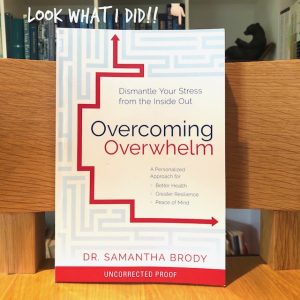
As you may know, my new book, Overcoming Overwhelm will officially be released by Sounds True publishing on January 1, 2019.
Part of me is excited to write this and the other part feels extraordinarily vulnerable as I officially introduce the book to the world. It’s been such a long haul with so many ups and downs. But in the end it doesn’t matter how I feel because this book is a book for YOU.
Overcoming Overwhelm isn’t a time management system, nor does it offer a litany of coping strategies. It’s not a book on minimalism or how to organize your files. Instead, it gives you a completely new way to think about overwhelm and offers a plan for dismantling it by providing an actionable, four-step plan that places control of your life squarely back into your own hands.
You can read more about it (and even check out a sample chapter) here.
So many of you have asked how you can get the book and how you can share about it, and I’m grateful—releasing a book to the world takes a village and I’m turning to you for help in this final push.
Here are a few ways you can help:
Pre-order the book now
This is the single most important way to help, both because I hope you will read and enjoy it and because the number of pre-orders really makes a difference in getting this book into bookstores, and therefore into the hands of the people who need it most. You can pre-order from online retailers or from your local independent bookstore via IndieBound.org. You’ll find all the options if you click on the button below. If you’re considering buying my book for a friend or loved one, now is the perfect time to order!
To thank you for your pre-order I will be gifting you with a copy of my e-book Stress-Less Outside the Box, full of unconventional ways to IMMEDIATELY start decreasing your daily stress and calming your mind. Don’t wait until January to start feeling better!
Share!
We all live in networks of connection. I would love to build a genuine community around this book together! I would be deeply grateful if you would consider mentioning the book on social media, or in your blog or newsletter if you have one. For Facebook, go here to share the link (pinned) to the pre-order page. For insta, share my handle @DrSamanthaND and mention “link in bio.”
Use the hashtag #OvercomingOverwhelm so I can find you and share again.
If you want some memes or pre-written content to share, please hit reply, we’ve got lots of assets you can use across platforms. If you have any connections to bloggers or podcasters you think would be a good match for the me and the book, please hit reply and let me know.
Read Overcoming Overwhelm with a Friend or a Larger Organization.
Consider purchasing an additional copy or a few to dismantle the stress in your larger community. For example, if you have access to a large group of people through your company, community center, spiritual home, or other group and you feel they would enjoy or benefit from the book, consider donating a box of books or asking your organization or company to purchase them for members or employees (contact my publisher Sounds True at sales@soundstrue.com.) Or if you have someone you can put me in touch with about purchasing books, I would be so grateful. Just hit reply and let me know.

Apply to Join the Street Team
I’m looking for a select group of community members to help me promote the book! I want this book to be so easy to find that overwhelmed people will simply stumble upon it when they are lost and looking for a foundation to stand on. To make that happen, we need a village. The Street Team will help spread the word about the book on social, to friends, and within their communities. My team will provide ideas for sharing about the book as well as memes, quotes, and other goodies you can use for posting. As a thank you, you’ll get an advance reader copy of the book (right away!), free access to my Energy Academy course, and more. Let’s spread the word about this book far and wide. Your words matter. Click on the button above this section to learn more about the Street Team.
Learn More About the Street Team HERE!
Thank you all for your great support through this journey. This book is so needed in the world and I appreciate any way you can help—big or small.
Yours in Health,

 It can be challenging to do all the things we feel we should be doing and changing to create better health, greater resilience, and peace of mind. The reality is that it’s impossible to do them all. So what can you do? In my book Overcoming Overwhelm:Dismantle Your Stress from the Inside Out I go through a process with my readers to get clear about what is most important so it becomes easier to figure out not only exactly what stresses are impeding you from living the life you want to live, but also which things you can, and will address to get there.
The first, and perhaps most important step to figuring this out is to be clear that every stress in your life will fit into one of three categories: things you can’t change, things you can change, and things you choose not to change.
Things You Can’t Change
There are always things in life that are out going to be out of your control. People disappoint you. Companies undergo mass layoffs. Your car gets sideswiped. Termites get at the foundation of your house. Your country elects officials that you are ideologically opposed to. The list goes on and on and on. When you’re faced with these events and situations, it’s easy to get down or feel overwhelmed.
Ultimately, though, if we let ourselves get anxious, down, or immobilized because of things we truly can’t change, we are setting ourselves up for a long and difficult haul. And there is another option: acceptance. That doesn’t mean you have to be happy about injustice or difficult circumstances, or that you should stop fighting for what’s important to you, but it does mean choosing not to let it undo you.
Things You Can Change
The number of stresses in your life that you do have control over—things you can change, if you choose to—dwarfs the number of stresses that you don’t. In step 3, you will be identifying many things in your life that you could change in order to give yourself more time, space, and energy. You may or may not change them all—or certainly not all at once—but I want you to know that it is well within your power to make easy, impactful shifts in your life. The less you feel like a victim of stress and circumstance, and the more you exercise choice in your own life, the less overwhelmed you’ll be.
Things You Choose Not to Change
Just because you can change things doesn’t mean you will choose to change them, or that choosing to change them is even the best option. You could move to get away from the noisy neighbors, but that would mean taking your child out of a school that is a great fit. You could cancel cable and get a gym membership, but watching football is how your family connects after a long, busy week. Life is complicated. We have responsibilities and commitments. We have many things we want to do.
Given that, I want you to acknowledge that there are some things you know you should do but aren’t up for doing right now. If you acknowledge that you are choosing not to change something—be it more significant (a relationship or a job) or less significant (staying away from coffee or not using plastic water bottles)—you can stop judging yourself and get on with the things that you are willing to do. This decision puts control firmly back in your own hands and reduces stress you add to your life by worrying about all the things you’re not doing or why you can’t surmount the limitations of time, space, and gravity.

An example
At thirty-six, Melissa came to my office after a disheartening experience with her primary care doctor. She had gone to see him for knee pain the week before and after taking her vital signs and putting her on the scale, instead of giving her practical help for her pain, he spent about fifteen minutes shaming her for her weight. He ignored the fact that she had hurt her knee dead lifting. He just focused on her weight, telling her that she needed to lose seventy pounds as quickly as possible, as this was the cause of her problem. He never even touched her knee.
She told me that over the last ten years she had been on a merry-go-round of dieting, losing weight, getting off track, and gaining the weight back again. She said, “I’m fat, and it’s not healthy. I’m ready to lose weight.”
I looked through her intake forms; I asked her a slew of questions; I reviewed her lab test results from the last three years. She had no health issues other than some fatigue and knee pain—and I felt confident neither of those issues was related to her weight.
I looked her in the eye and said, “You’re not fat; you have fat. And you’re perfectly healthy.” She burst into tears.
At that point I suggested that she put her weight in the “choose not to change” category and focus instead on eating more healthfully to improve her energy and decrease her inflammation. We treated her knee with anti-inflammatory herbs and acupuncture. After a few months, she felt great.
You might expect me to add, “and she lost thirty pounds just from making the changes to her diet!” But she didn’t—and that’s just fine. To truly be healthy, she didn’t need to lose weight; she needed to offload her futile struggle with dieting and her feelings of shame and powerlessness. She remains healthy, eating well and exercising to this day.
In sum
YOU are in control of your choices. That doesn’t mean that shitty things won’t happen or you won’t be a victim of circumstance but you get to decide how you will respond to those things. So feel those feelings, be honest with yourself, and commit to dealing with whatever it is that is keeping you from getting to the other side.
Yours in Health,

 Salt has gotten a really bad rap over the years. It is known to cause high blood pressure and increase the risk of heart disease. But is it really as bad as it is made out to be? How can something we require in our diets be so bad for us?
Our nervous systems and muscles require adequate amounts of salt to function properly. Not getting enough salt in our diets can lead do headaches, increased thirst, confusion, and in severe circumstance (an unlikely case scenario) in combination with a low potassium diet, a higher risk of death (gulp!) That said, too much salt can also be problematic. And to complicate things more, the type of salt is important too!
Who needs extra?
It is very rare for someone living in the United States to have a sodium or chloride deficiency. In fact, the average American is consuming two times more than what is recommended each day! This is because most of the salts we consume as Americans comes in the form of processed foods. It is estimated that for the average American, 75% of our intake comes from processed foods, 15% from table salt, and 10% from salts founds naturally in foods. BUT if you eat a healthy diet without much processed food, as long as you don’t have high blood pressure you can likely skip worrying too much about it.
Food Processing Increases Sodium & Depletes Potassium
 For the health-conscious individual who consumes little to no processed food it is virtually impossible to consume too much salt. This is because the tongue’s taste receptors will not allow for it. When it is added to foods it ends up on the surface and the taste is readily picked up by the tongue’s receptors. Salt in processed foods is not on the surface of the food and its flavor is often masked by additives such as sodium bicarbonate or sodium saccharin. Although you are getting large doses of it you do not really sense these processed foods as being “salty.”
For example, one ounce of salted peanuts contains 116 mg of sodium, one cup of cornflakes contains 182 mg of sodium, and two slices of white bread contain 344 mg of sodium. We typically do not think of cornflakes or bread as being salty foods, but in reality, they contain more sodium than salted peanuts!
Salt, Blood Pressure, & Heart Disease
Many studies have shown that decreasing dietary salt consumption has the ability to lower blood pressure and decrease the risk of cardiovascular disease. The DASH diet, which emphasizes fruits, vegetables, whole grains, poultry, fish, nuts, and low-fat dairy products is low in sodium and high in potassium and has been shown to be very effective in reducing blood pressure. Note that the DASH diet is free from processed foods. This is because as food is processed the potassium in it is depleted and the sodium content is increased significantly. When there is a proper sodium and potassium balance in the body, which is promoted via the DASH diet, people tend to be healthier. That said, there are many other benefits of avoiding processed foods so part of the benefit of the DASH diet actually be from better eating rather than avoiding salt.
Which Form is the Best?

Not all forms are the same. You have probably seen all kinds of salt at the grocery store. There is standard table (iodized or non-iodized), sea, Celtic or Gray Sea, Himalayan or Pink, Hawaiian, and Real.
Standard table salt is highly refined and may even be sourced from byproducts of crude oil manufacturing. Standard table salt can also come from a natural source. It is then exposed to high heat and mixed with potentially toxic anti-caking agents which prevent it from clumping together. Many sea salts and Hawaiian salts are manufactured in this way as well. It is obviously not an ideal type to consume.
Fortunately, there are deposits which exist in the world that are harvested naturally and are minimally processed. These include Celtic or Gray Sea, Himalayan or Pink, traditionally-produced Hawaiian, and Real. Celtic, Gray Sea, and traditionally-produced Hawaiian come from the ocean and may contain environmental pollutants. Himalayan, pink, and Real are harvested from salt mines and are likely the healthiest forms available today. All unrefined salts contain mostly sodium chloride but also contain trace minerals such as calcium, magnesium, and potassium.
The take home.
Eat whole foods, low sugar, good quality fat, and enough good quality protein. Don’t stress about salt unless you have high blood pressure or kidney disease, or are on a medication that your doctor has informed you can be problematic with salt intake.
Yours in Health,

Collagen powder has great benefits, not the least of which is the fact that when you find the right kind it is a great sub for protein powder…watch to find out why!
Caveat: it’s not vegan so if you need a vegan protein powder I’ll be addressing that in a future video! In the meantime you can read my blog post on different kinds of protein powder here.
Find more about this topic using the search sidebar or topic menu.
Add more energy to your life every day.
Get 7 days of energy-infusing practices delivered to your inbox, FREE!
