
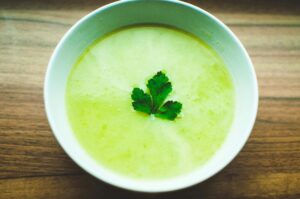
 This recipe is an adaptation of one I first made about 30 years ago (in my vegan days) from The American Vegetarian Cookbook from the Fit for Life Kitchen by Marilyn Diamond. Better hot but also good cold IMO!
There have been many incarnations of this soup in my life, including as a staple at the health food deli where I worked–along with a catering job–to finance an 8-week trip to an ashram in India (that, my friends, is a story for another time.)
Lately I’ve simplified the soup to the bare bones for a quick and delicious low allergen side dish. Sometimes I have this with a side of tempeh, sometimes chicken, and it’s a really great side with salmon.
(more…)

🎂 I DID IT!
I’m so excited to start the new year with the official launch of my new book Overcoming Overwhelm: Dismantle Your Stress from the Inside Out!
My sincere thanks to everyone who pre-ordered and everyone who is going to order now that it’s officially ready to ship! (hint, hint). 😊
Want to read before you buy? Check out the sample chapter at the download over on the book page.
I’ve been loving your stories of putting this advice to work and can’t wait to hear more. Feel free to tell me how it’s working for you on my contact form!


“There are a few things I really admire about this book. First, in the opening chapters, Dr. Samantha points out that stress is an inevitable part of life, and that anybody who tells us that they can help us get rid of stress is basically lying. She wants to distinguish between stress, which is normal, and feeling overwhelmed, which is really because of choices that we’ve made about how to live our lives. I had to laugh, as a yoga instructor, when she points out that all the things that “experts” have been telling us to do to lower stress (yoga, meditation, massages) can actually increase our sense of being overwhelmed because it just adds more things to our day.
Another thing I really admire about this book is how the stories she tells about her patients go completely against what most so-called self-help books say. One of my favorites is the story of the triathlete who decides love is more important that peak fitness. But, I think my absolute favorite is the story of the woman whose doctor fat-shamed her about being 70 pounds overweight, and who breaks down in tears after Dr. Samantha tells her that she’s beautiful exactly how she is and that there’s no medical reason for her to lose weight. Dr. Brody encourages us, in the book, to decide what things are important to us, and not worry about what society as a whole is telling us to do.
She has a bunch of exercises in the book, which take some time to go through. But the first one, identifying what our values are, has been the most profound soul-searching I’ve done in a long time. It’s a very simple exercise, but for me, it helped me realize that certain things that I thought were valuable to me really weren’t, and things that had been hovering in the back of my mind really were very important things that I valued that I hadn’t spent much time pursuing.
Ultimately, the book presents an overall life strategy that seeks to help us stop feeling overwhelmed by our lives and by our society. Spoiler alert: you have to say no to people and stop doing things that add nothing to your life. I think this is a book that I’ll return to over and over as the circumstances in my life change, so that I remind myself of what my “True North,” as Dr. Samantha calls it, is. I really think this is a valuable book that could help a lot of people.”

 This exercise is a great start for understanding what is most important to you. Think values and ideals you would want to line up with your choices on a daily basis. If you’re trying to have less stress, if you want to be less overwhelmed, lining your choices up with your values is a big piece of making that happen.
Of course here and there we always make choices that aren’t truly lined up with who we are, or who we want to be but even being conscious of when we’re choosing that can be a game changer.
THE EXERCISE:
I pulled my list from several sources but the list could be endless, really. The list we use in my book Overcoming Overwhelm: Dismantle Your Stress From the Inside Out long and quite comprehensive. You can download it along with the full exercise HERE. And while you’re at it, you are also welcome to download a sample chapter from the book as well!)
And if you want more values to choose from/consider you can also ask the google—there are many similar versions of this exercise online!
For the record, I find that for most people core values are relatively stable over time, though they can change with big paradigm shifts, of course.
What I want you to do is think about the things that are most important to you. Think about which of these things, or other ideals you would want your choices to line up with on a daily basis.
- Go through a values words list and circle anything that you would consider to be important to you.
- Add anything that you think is important to you that you didn’t see on this list.
- Organize the words you chose into groups by similar meaning.
- For each group choose one key word that could represent all of the words in that group. For example if you chose dependability, ethics, fairness, honesty, integrity, loyalty, trustworthiness. You could choose ‘integrity’ because it encapsulates all of the words in this set. If there are some that stand alone, this would be a key word.
- Make a new list with these key words.
- Choose your top ten values from this list.
- Finally, narrow it down to your top five. I know that can be difficult, and it doesn’t mean that the words that don’t make it into your top five aren’t important values, but you need to know what is most important.
The download has an expanded version of these instructions as well.
Happy New Year!

PS If you want some ongoing support for making choices in alignment with your values, please join me in my Facebook group Dr. Samantha’s Health Forum. A totally non-judgmental place to work on your health, energy, and peace of mind.


After working in the supplement industry I can tell you one thing for sure. Finding good quality products is more difficult than you would ever imagine. More here!
Find more about this topic using the search sidebar or topic menu!

 You’ve heard it time and time again: “Exercise is good for you!” “You have to exercise to stay healthy.” And although any exercise is better than no exercise, it is becoming more and more clear every day that strength training is more beneficial with a greater range of benefits than cardio.
What is strength training?
Strength training, also known as resistance training is using some kind of weight to lift to get a workout. When we think about strength training, many of us think about buff, leering, self-involved dudes at a Gold’s Gym. But it’s so much more than that. You can strength train by lifting weights or using exercise machines, but you can also strength train by practicing certain kinds of yoga, playing parkour, or even by lifting your children into the air. The weight used can be an external weight or the weight of your own body.

What is “cardio”?
This term is short form for ‘cardiovascular exercise’ and usually refers to increasing your heart rate a certain amount for a protracted period of time. This typically involves running for long periods of time, brisk walking, swimming, or biking. Cardio is not considered a strength training exercise; you are not lifting anything when performing a typical cardio workout. (And please, I beg you, for the love of your healthy joints, don’t lift weights while you’re in motion!)
What kind of exercise is most effective?
It is important to recognize that any form of exercise, so long as it is not causing injury or illness, is better than not exercising at all. In general, exercise allows for the development of coordination and motor skills, increases endorphin production and therefore feelings of happiness. It promotes stress reduction, pain reduction, lowers blood pressure (long-term), enhances the immune system, and decreases the risk of developing chronic diseases. (Uh, hell yes, sign me up, please.) You should be able to run away from an angry pig. You should be able to use your body to pull yourself up a rock to safety.
But, if you are looking to get the greatest benefit out of exercise while reducing the risk of harm, strength training is what I recommend. When exercising, it is ideal to put your body under the least amount of stress possible while receiving maximum benefit. When you go for a long run or bike ride you are actually doing the opposite. Exercising at low intensity for long periods of time taxes your joints and organs tremendously. When you exercise you produce reactive oxygen species, also known as free radicals. The longer you exercise, in general, the more you are producing. These free radicals are the things that cause damage at the cellular level and increase the risk of developing disease. Several studies have shown that long cardio sessions increase the release of cortisol (a stress hormone), raise the risk of cardiac disease, can cause scarring on the heart, and lead to insulin resistance, which increases the risk of developing type-2 diabetes.
What we understand now is that although cardio exercises can help you get in shape to some degree, a far more effective approach to exercise is strength training.
When you lift moderate to heavy weights three times a week with proper form you have the ability to control the stimulus you are inflicting on your muscles much better. You reduce the risk of injury tremendously because of this. There is much less of a chance for you to lose proper alignment or misstep which is often a cause of injury. High intensity strength training has been shown to be the most effective way to enhance fat loss and increase muscle mass. Strength training also improves insulin sensitivity which lowers the risk of most chronic diseases.
Additionally, strength training improves mobility and balance, posture, increases bone density, and reduces the risk of osteoporosis. What is even more awesome about strength training is that you get all the benefits of cardio without all of the risks! If you perform a set of an exercise and only wait 30 seconds before jumping in to the next set, you will get your heart rate up and improve your conditioning. I will often drop to do a set of pushups to get my heart rate up, or pick up a kettlebell and do some swings. (Please be sure that you have someone show you how to lift properly and give you feedback on your form. You may need to hire someone for this, but it’s well worth mitigating the risk of injury, which will cost you much more in the end.)

More reps lower weight or fewer reps higher weight?
Lifting moderate to heavy weights with good form should provide tremendous, noticeable benefits in a relatively short period of time. You will probably start noticing benefits within a month and marked differences in your body shape and tone by the third month. To be honest, it can suck at first as your body gets used to this type of exercise, but it is worth it!
Again, if you’ve never lifted weights before, get the help of a qualified personal trainer. They will put you on the right track so you get the best use of your gym membership. And, remember, hours and hours of cardio is probably doing you more harm than good, and it is definitely not necessary for your health and fitness goals. You’ll reach your goals much quicker by incorporating a strength training routine into your week. Doing some cardio, if you enjoy it, is perfectly fine, but it is important to recognize that strength training is essential.
Yours in Health,


Around the holidays, we so often feel responsibility to do things and go place and be around people we would rather not. The answer isn’t hiding in your house (which, to be honest, is my default) but is carefully vetting what you say yes to, and making sure that you get firm and clear in your boundaries around what (and who) you are willing to put up with. Be honest with yourself. Be honest with your loved ones. In the end this will serve you more than putting on a happy face and forging forth with discomfort and unease.
Here are a few short excerpts from my book Overcoming Overwhelm: Dismantle Your Stress from the Inside Out that might help you reframe what you are saying yes to over the holidays:
Emotional Contagion

Human beings are prone to picking up the emotions of the people around us. This is known as emotional contagion. Studies show that the people we work with impact our emotional state. Spouses of depressed individuals are more likely to be depressed, as are their children and even their roommates. One 2014 study even looked at Facebook posts and
provided evidence that “emotional contagion occurs without direct interaction between people . . . and in the complete absence of nonverbal cues.” This is a great example of how important your virtual environment is to your health and wellbeing. It is a real part of your world.
Who you spend your time with will affect how you feel. If you spend all your time surrounded by people who are negative, it is harder to stay positive. If you surround yourself with people who are anxious all the time, you’ll be prone to anxiety. If you surround yourself with people who cut you down, you’ll start to believe that you’re less than you are.
Consequently, if you want to keep your stress down and your mood up, choose to surround yourself with people who uplift you, wherever and whenever you have a choice.
Self-Sacrifice and People Pleasing
Being raised to believe that a good person puts others first, or being a people pleaser at the expense of your own needs, can be huge roadblocks to creating the life you want to live. Of course, it’s okay to do things for other people; that makes you a good human. But if you put other people first all the time, and what’s most important for you is to make someone else happy, you will never be able to prioritize what you need to do to take care of yourself.
Although self-sacrifice and people pleasing can be an issue across genders, women, in particular, feel pressured to take care of others before ourselves. I posed to readers of my Facebook page: “What keeps you from doing the things you need to do to take care of yourself?” In response, one woman wrote, “The ‘people pleaser’ part of my personality. Hijacks me all the time. I’d rather work to the bone to make someone happy than risk being a disappointment to them.” The idea that it is selfish to prioritize our needs over that of our co-workers, our bosses, or our families, that self-sacrifice is the noblest ideal, has deep roots in many cultures and religious traditions. But the story that we should take care of everyone else first, while certainly influenced by societal expectation, can also stem from a deep sense of unworthiness.
 Learning how to be discerning in what we give to others, so as not to deplete ourselves, can be difficult. But it’s important—and not just for your own well-being. Building up your reserves of energy is imperative for taking care of others, too. If you want to be able to do your best job, you need to put yourself first, at least some of the time. Imagine trying to rescue someone from drowning, when you’re exhausted, cold, alone, and don’t have your own flotation device.
If people pleasing or compulsive caretaking and self-sacrifice are issues for you, ask yourself whether you are consciously choosing to put others first because that reflects your values, goals, and priorities, or whether it’s just a knee-jerk pattern in your life.
There are some people for whom taking care of others even at the cost of their own well-being does align with their values. And there are times when you may need or want to put others first, like my client Susan did (see chapter 4). But if you know you compulsively put others first and want to change it, then start practicing saying no—to small things first, perhaps—and not apologizing when you make a choice to do something for yourself.
Saying no in order to take care of yourself is like exercising a muscle.
Each time you do it, the easier it is the next time—both because people learn not to expect you to say you’ll pick up the slack, and because you realize that it’s not the end of the world if people are disappointed.
Some people will always be disappointed in you. And in every relationship, you’ll cause some disappointment. This is life. Avoiding disappointing others at all costs only hurts both you and those you love.
Yours in health,


Add more energy to your life every day.
Get 7 days of energy-infusing practices delivered to your inbox, FREE!
