
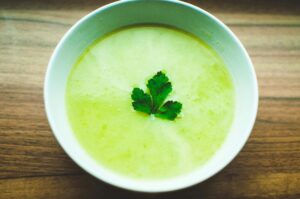
 This recipe is an adaptation of one I first made about 30 years ago (in my vegan days) from The American Vegetarian Cookbook from the Fit for Life Kitchen by Marilyn Diamond. Better hot but also good cold IMO!
There have been many incarnations of this soup in my life, including as a staple at the health food deli where I worked–along with a catering job–to finance an 8-week trip to an ashram in India (that, my friends, is a story for another time.)
Lately I’ve simplified the soup to the bare bones for a quick and delicious low allergen side dish. Sometimes I have this with a side of tempeh, sometimes chicken, and it’s a really great side with salmon.
(more…)


I grew up in Connecticut with parents who migrated there from Brooklyn and Queens because, well, that’s what most of their peers aspired to. As was the tradition in his family, my father and I went to the deli every Sunday morning and picked out a dozen slightly overdone bagels. Salt or plain. Thin sliced Nova Lox. Whipped cream cheese. And Kenny, behind the counter at Gold’s, would always give me a big fat salted pretzel. On a good day (if the Giants were playing and might actually stand a chance) I could also talk my dad into getting me a few of those little mini salamis that would hang off of the back wall like crepe paper streamers at a birthday party.
You can imagine my horror when I moved to Portland and found that the bagels here are, well, not bagels. Almost 20 years after my arrival we did get one place in town that had almost an East coast bagel, but alas they just got bought out by some big chain who, of course, just ate them up and didn’t bother to keep the recipe.
Truthfully, after the initial shock I didn’t really care. I’ve been off of wheat for years and I’m not really a carb cravin’ kind of girl. But funny enough, now that I’m gluten-free as well (feeling so much better by the way, but that’s another post altogether) I’m a bit more focused on the specialty items in the store. Today at the co-op I saw a gluten-free bagel by New Cascadia Traditional. If I didn’t actually roll my eyes I’d be surprised, but thankfully I was alone.
I bought it.
I brought it home.
I toasted it.
I took a tiny bite. Then I ate the whole thing.
Lo and behold, it was good! The texture was bagel-like. Not perfect. Not Gold’s. But certainly as close as any so-called bagel I’ve gotten in Portland in the last 2 decades. The outside is crunchy, the inside chewy. There’s a tiny bit of bitter taste to the dough, but with toppings, it’s barely noticeable.
Next weekend I’m going on a hunt for Nova lox (ooh, I bet I know who will have the answer to that.) And I’m going to serve my five-year-old bagels and lox. Perhaps it will become a new tradition.
 I am not one to follow mass media or get on a fad, but when I heard Dr. Oz interviewed on the Today Show about what he discovered surveying the “healthier” people in America, I wasn’t surprised. I wanted to share with you my take on the 5 healthiest habits per Dr. Oz.
Habits of the Healthiest:
These are the habits that came up as the top 5 habits of people who are the healthiest per Dr. Oz. I’m addressing each of these below with why I personally think this is the case. Let us know in the comments what you think.
1. Breakfast. This is the most important meal of the day. When we sleep, our body goes through a process to reset our system, increasing the automatic mechanisms through the night so that we can be ready in the morning for the coming days work. Fueling in the morning continues this automatic system of energy in and energy out. Our metabolism is primed for what is to come.
2. Exercise. As an industrialized community, being sedentary is easy. We no longer need to hunt and gather our food or travel great distances of our own accord to get to our destination. Our bodies have developed over many centuries to move. The inner workings of our heart, blood vessels, muscles, and lymphatic system love movement. Our cells crave activity so that flow can happen; it is the difference between a clear running creek vs. a stagnant swamp. If we move, we are rejuvenated and feel fresh (physically and mentally), if we stagnate, we start a build-up of unwanted debris.
3. Sex (healthy relationships.)
Dr. Oz keeps it strictly to sex but I think that this falls under a greater category of “healthy relationships.” We are social beings. It is important to our overall feeling of well being and motivation to be connected. Building a satisfying relationship, whether it is with a physical partner or with other individuals that share interests and we work and play well with helps our overall sense of well being.
4. Me Time.
In our fast paced society, it seems we are running around from one activity to another for someone else. We sometimes feel guilty for slowing down and doing things that we alone enjoy. It is important for our mental health to find activities that as individuals we enjoy doing without the pressure of others taking or wanting our time. We can only care for others if we ourselves are cared for.
5. Stress Management.
What is this? Some stress is important, but too much is detrimental to our physical system. We can run ourselves ragged if we don’t give time to reboot, or if we ignore symptoms of too much stress. Ailments like high blood pressure, headaches, migraines, cardiovascular disease, diabetes, multiple sclerosis, autoimmune disorders, etc., and many more, are all linked to excessive stress. The habits mentioned above actually will help with decreasing and alleviating stress. There are many ways we can reorganize our daily life to “fit” everything that is really important to us in, without the negative consequences.
Be Healthy.
-Dr Butler
 By Dr. Beverly Butler
When was the last time you went to the doctor?
Blood pressure checks are a regular exam done when you go to the doctor. Basically the top number (systolic) is the max pressure your heart produces with contraction (at rest). The bottom number (diastolic) represents the heart relaxing to fill chambers.
High Blood pressure has been dubbed as the “silent killer” for good reason. Our hearts beat automatically, we don’t need to think about it. And our hearts will work overtime for us. But if we don’t pay attention and allow our blood pressure to rise too high over time it can lead to devastating results including cardiovascular disease, kidney disease, stroke, peripheral vascular disease, and end organ damage.
High Blood pressure is defined as readings over 140/90, prehypertention is anything between 120/80 and 140/90. There are also other concerns associated with age and risk factors, for instance, isolated systolic hypertension is of concern for the elderly (larger difference between top and bottom numbers). Also, recent studies show that the difference in pressures between the right and left arms can be associated with disease risk.
What does this all mean? How can you avoid problems with high blood pressure? It is important to make sure you see the doctor at least once a year and have a checkup done. Tell your doctor about your family medical history and ask questions about your own risks. If you are younger, know that it is important to follow a healthy lifestyle now so that in the future (when hardened arteries are more prominent) you can stave off any negative influences and live a longer healthier prescription-drug free life. If you are older, know that there is no “too late” to incorporate healthy lifestyle changes for heart health.
What helps keep your blood pressure healthy?
- Ideal weight
- Stress Reduction (adequate sleep, time to enjoy life, meditation, prayer, acupuncture)
- Exercise (regular, 3-5 times a week 30 minutes or more)
- Plant based foods high in nutrient content, lean proteins, and avoiding trans fats
- Specific minerals such as magnesium and potassium at the right dose for you
- Omega 3 fatty acids (!)
*Talk with your doctor before implementing the above suggestions, especially if you are on medications or have already been diagnosed with hypertension.
While we may feel “fine” going to the doctor at least once a year is important to review your health history, risk factors, healthful or lack of healthful practices. Working with a naturopath, health coach, or other lifestyle/health educator can help to target your needs as well as keep you motivated in keeping healthy habits.
For more information:
http://www.heart.org/HEARTORG/
http://www.medicinenet.com/high_blood_pressure/article.htm
http://www.medicalnewstoday.com/articles/240931.php
http://ods.od.nih.gov/factsheets/magnesium/
http://www.ncbi.nlm.nih.gov/pubmed/8339414
Oh, and If you suspect high blood pressure or you have high blood pressure it may be helpful to get yourself a home cuff to monitor your own blood pressure. You can then identify what triggers your high readings to report to your physician. They have them on Amazon- patients seem to like the Omron cuffs, as they are easy to use and relatively inexpensive.
Take Care,
Dr Butler

 Every year around this time I get an influx of patients who are sick. Runny nose, cough, irritated eyes, full ears. And often enough it’s the same patients year after year. I get out my thermometer, stethoscope, peek in their ears and ask “Are you sure it’s not your allergies acting up?” “Oh, right! But isn’t it too early?” Some hop right on Claritin or Zyrtec and it’s a done deal. For others, this doesn’t work as well as they would like or there are too many bothersome side effects. And in some cases it doesn’t work at all. Most who seek care with me are willing to take a medication if it’s a last resort but would prefer to address things as much as possible on their own. Or at least with a lower dose or a less heavy hitting medication.
If you’re a regular reader you’ll notice that I tend not to write entries that suggest that you ‘do this’ or ‘do that’ to treat any given condition. That’s not about keeping secrets, it’s about doing my part to advocate for what we do best as naturopathic physicians. What makes our approach unique is that each person is treated with a slightly different approach, no matter what the “diagnosis.” In our office, anyway. We believe simply that there isn’t one test, drug, herb, nutritional approach or supplement that should be thrown at all patients.
So given that, there are four basic tenets to how we approach allergic patients. Though there are some things that are very patient specific there are also some things that anyone can do to help decrease symptoms.
1. Avoid exposure to your offending allergens. If you don’t know what they are, get tested. You don’t necessarily have to treat them the way the allergist wants you to, that’s your call, but knowing specifically what you’re allergic to may help you figure out how to at least decrease your exposure. Here are some other ways to decrease general allergen exposure.
- Neti pot or other sinus irrigation. Please use distilled or boiled water or you may end up with a brain eating amoeba (ok that’s unlikely but it did happen once, somewhere, so better safe than sorry.)
- Use air purifiers in as much of your home as you can. Non –negotiable in the bedroom.
- Wash your hair before you go to bed, or rinse it at least. When you’ve been walking around all day you get pollen in your hair then roll your face around in it all night.
- No “day clothes” in bed. Or even get out of outside clothes entirely when you get home if you have severe allergies.
- If you suspect a dust mite allergy at all (via testing or waking with allergic symptoms.) Get barrier covers for your mattress, sheets AND comforter. If you use blankets, wash them weekly.
- Don’t dry your clothes outside.
- If working in the yard really irritates you see if you can pawn this off on another family member or source it out. Wear a mask if you need to.
2. Thin mucus.
- Drink plenty of water.
- Consider supplements that have this function. We call these mucolytics. There are a number out there and this is one of those places where it is really best to tailor prescribe.
3. Stabilize mast cells- the cells that release the chemicals that cause allergies into your bloodstream and local tissue.*
- Vitamin C.
- Quercetin and bioflavonoids.
4. Balance the immune system. This is the most complicated part of addressing allergies. Allergies are your immune system inappropriately overacting to a stimulus. Folks who suffer with allergies often get sick more often than their non-allergic peers because their bodies are so busy fighting off that crazy dangerous pollen they don’t have the resources to fight off a virus, or bacteria. Not to mention that viruses and bacteria find the dark damp milieu of the allergy sufferer’s respiratory tract the perfect environment for settling in and multiplying. It’s a fine balance that we address with personalized nutritional recommendations (though for everyone, watch the sugar- it decreases immune function, and watch the dairy, it makes more mucus.)
* I’m working on a short video that explains the nuts and bolts of this process, so if you’re interested, sign up for our weekly newsletter. The plan is to give a weekly health tip, links to our new blog posts, and a running list of current important bits of health news!

 A recent research article was published with the finding that the scent of rosemary improves brain performance. Since I’ve got a lovely old rosemary bush in the back yard I figured why not set my sights on developing some recipes that incorporate this lovely and aromatic herb? I mean, who can’t use a little bit of extra brain power, right?
My first thought- frittata. A quick Google search “rosemary frittata” led me to the website of an ND turned recipe developer/food photographer/health blogger, Winnie Abramson. Her blog Healthy Green Kitchen is absolutely lovely through and through. I recommend you check it out. Her frittata was similar to the one I usually make so although I didn’t use her recipe I’ll link it here as I’m sure it’s absolutely fabulous.
Ingredients 
- 3/4 to 1 lb of very thinly sliced red potatoes (you can skip the potatoes or use fewer for lower carb macro balance)
- 1 cup of diced onion
- 5 cloves sliced garlic
- 3 cups tightly packed chard cut into fine strips (this was a whole head for me)
- 4 TBSP olive oil
- 2 TBSP minced rosemary
- 6 farm fresh eggs beaten and mixed with ½ cup cool water
Instructions
- In a large oven safe skillet (I use a giant cast iron pan) over medium-high heat sauté potatoes 3 TBSP olive oil until lightly golden brown and cooked through.
- At the same time in a smaller skillet, also over medium-high heat, sauté the onions and garlic slices in the remaining TBSP of olive oil. Once the onions are cooked through and lightly browned add rosemary and toss for about 30 seconds.
- Add the chard to the onions mixture and sauté until well wilted.
- Once both the potatoes and the vegetables are done add the veggie mixture to the potatoes and lightly toss.
- Turn on broiler.
- Pour eggs over vegetables in large skillet and leave over medium heat until the eggs set well around the edges.
- Put the frittata under broiler until eggs are completely set and the top is lightly browned. Should set in 8-10 minutes.
 This fed the three of us for dinner with enough left over for my kid to take to school for lunch tomorrow. And the house smells divine.
Enjoy!
-Dr Samantha
Add more energy to your life every day.
Get 7 days of energy-infusing practices delivered to your inbox, FREE!
