
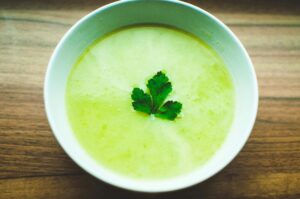
 This recipe is an adaptation of one I first made about 30 years ago (in my vegan days) from The American Vegetarian Cookbook from the Fit for Life Kitchen by Marilyn Diamond. Better hot but also good cold IMO!
There have been many incarnations of this soup in my life, including as a staple at the health food deli where I worked–along with a catering job–to finance an 8-week trip to an ashram in India (that, my friends, is a story for another time.)
Lately I’ve simplified the soup to the bare bones for a quick and delicious low allergen side dish. Sometimes I have this with a side of tempeh, sometimes chicken, and it’s a really great side with salmon.
(more…)
Your skin is your biggest detoxification organ. If your body isn’t healthy it can literally show on your face, or anywhere on your body for that matter. In naturopathic care, we focus on getting your body to feel healthy and in return you will look healthy too. The fundamentals of healthy living for your body also apply to your skin and face.
The beauty industry is a multi billion dollar industry. There are so many products and treatments and diets out there to help your skin look healthy, but which things really work? Which should you choose? Here’s what I think is most important.
1. Hydration. Water is an essential part of a healthy skin regimen. When you drink water it eventually gets to every other organ in your body. The very last place it will reach is your skin so stay well hydrated by drinking enough water every single day.
2. Antioxidants. Free radical damage from regular metabolism of cells is intensified with sun exposure. The skin is most vulnerable. The damage from the sun disrupts the skin cell lining and lead to sunspots, age spots, wrinkles and the worst culprit cancer. Antioxidants protect from free radical damage. You can find them in the following foods.
- Vitamin A (beta carotene): green leafy veggies, intense colored fruit and veggies
- Vitamin C: citrus fruits, broccoli, strawberries and green peppers
- Vitamin E: green leafy veggies, nuts, and seeds
- Alpha-Lipoic Acid: broccoli, spinach, collards, chard
- DMAE: salmon, sardines, and anchovies
3. Sleep. Your cells repair and regenerate while you’re sleeping. There really is such a thing as beauty sleep! 8 hours. Get it!
4. Topical Treatments. There are 4 important steps to follow with any skin care ritual
a. Cleanse: it is important to remove excess make-up and dirt and remove some oil from the skin, gentle is usually better, abrasive cleansers are too drying for most skin types.
b. Exfoliate. We have several layers of skin. Exfoliation reveals the healthy living tissue underneath the top dead skin layers. It also may reduce large pores and give more of a glow to otherwise dull thick layered skin.
c. Moisturize. Back to the first important rule of skin care; hydration. A good moisturizer after a cleanse helps to keep water in, giving the cells water to plump up and not be dry and shriveled.
d. Protect with Sunscreen. Sun damage, specifically free radical damage, is not good for any cell – and the skin is most vulnerable. Using a good sunscreen every day (30+) will keep your skin healthy and will ward off premature aging. See this site for choosing your sunscreen.
By Sarah May
In the fall when the weather starts to get cooler, I notice that I am suddenly drawn back into my kitchen again. Roasting squash, simmering soups, and baking fruit pies is nourishing to both body and soul…..
It turns out this is not a coincidence, and fits into the teachings and energetics of Chinese medicine very well. In TCM (Traditional Chinese Medicine) theory, we refer to the Elements (wood, fire, earth, metal and water) and we also refer to different organ systems. Each organ system is associated in a yin and yang pair, and each pair belongs to one of the previously listed elements. The seasons also exemplify these five elements. For example, fall belongs to the metal element, and is associated with the yin and yang pair of lung and large intestine.
In the fall we observe in nature a return to the interior, or to the roots. The plants abandon their outward reaching to the sun, shed their leaves, and shift their energy inward in storage for the wintertime. It is also a time for us to mirror nature and to turn our attention inward again, to return to our roots.
Fall is a time for introspection.
As winter is the time for storage, the fall is a good time to decide what is for keeping in storage, and what is ready to be released so it does not take up valuable space. To be in accord with the energetic of the fall season, consider asking yourself some important questions. What do I no longer need that I can let go of? Is there any unresolved grief that I can release? Are there areas of my mental and emotional life that I can release so I may have more room for new life in the spring time? Fall allows this naturally so we can release old thought patterns and negative ideas.
When we release and let go, we create space to evolve and move forward.
Earlier I mentioned the Lung and the Large Intestine. In Chinese Medicine Theory, all nature is connected. The lung is associated with the fall season. The lung is responsible for inhalation, or inspiration, which is an inward movement energetically. As we inhale we move introspectively and receive energy from the world around us through our breath. When we exhale, we release that which we no longer need.
In the fall, consider doing this simple meditation exercise a few times each morning and evening with these notions in mind. Focus through breathing, returning energy inward to nourish the source, and in turn exhaling to release what is no longer needed.
(photo by Jeff Parker)
Last night I went to dinner with a naturopathic physician (ND) friend visiting from SF and two other NDs. We got on the subject of breakfast and one woman admitted that she truly dislikes eating before 4pm, and that she pretty much has to force herself to eat breakfast. Wow, me too, I thought. Then one particular comment she made struck me. “If I have to make myself eat anyway I might as well eat something really healthy.” Turns out she chucks down two giant sardines every morning. For real. She just leans over the sink and eats them because she doesn’t want her plates to smell like fish. Now, these aren’t just any sardines. They’re Vital Choice wild sardines packed in organic olive oil. But still. Sardines. Big, fat, fishy sardines. Then she tells us there are actually 3 to a pack and she gives the third one to her cat because she suspects that eating a third might make her vomit- and apparently cold sardines are “gross.” (Duh.)
OK. Now. This impresses me enormously. And it got me thinking. Could I take another step toward making a healthier choice in the morning than my typical fare? I know without a doubt it’s not going to be sardines. Though they are practically nature’s perfect food, I simply don’t have that kind of fortitude of spirit. But since I don’t like eating breakfast anyway, why not a double serving of veggies with my eggs? Or an uber green smoothie instead of just a green smoothie? If I start the day with a few cups of veggies I’m halfway to my daily goal without even trying. I feel good about my choice. Veggies give me a little extra energy, and though that might be in my head, I’m not sure it matters. And more fiber.
And if that’s not enough, a recent study showed that
people who eat 7 or more servings of fruits and vegetables are happier.
Can’t turn that down, right?
So this morning I got up at the crack of dawn about 10am and peered into the fridge. Thankfully there were no sardines but there was a bag of cleaned, cut, and washed kale pre-prepped from earlier in the week. I dumped half the bag in a bowl, added oil, salt, and nutritional yeast, tossed it and threw it in the oven to make some of my very yummy kale chips. (Recipe here for perfect chips every time.) Then I made breakfast.

Ingredients
• 1/2 head washed and cut kale- it’s ideal to do this with pre-prepped kale as dry leaves make it work better
• 1/2 avocado
• 1/2 lime
• 1 tsp or more olive oil
• pinch of sea salt
• optional: chopped cilantro and gluten-free croutons
What to do
- put kale in bowl large enough that you can toss it around without losing leaves over the sides
- massage avocado into kale until kale is wilted and soft
- add oil and continue to massage for a few minutes
- squeeze lime over kale, a little bit at a time, tossing between squeezes until it’s as limey as you like
- sprinkle a little bit of sea salt over the top, again, to taste
- add cilantro if you like
- ditto on the croutons
Make sure that you have a protein on the side or on top of the salad. I had poached eggs today but you could have leftover salmon, chicken breast, even carne asada or some kind of steak. Because really, kale isn’t just for dinner anymore.
Enjoy!
Dr. Samantha
 Just the other day, I remembered a “technique” I had in my first year of medical school. In order to memorize long lists of information, I would make myself flash cards and test myself on long walks. (Yup, I was the strange girl walking down the street with flashcards…) I don’t know when I first had this idea, but I’m guessing that I was just so tired of sitting on my butt, I gave up on the traditional sitting at my desk routine and took to the streets. Surprisingly, (or not so surprisingly according to current research), it actually worked. I was able to memorize the facts faster, and they consolidated into my long-term memory, so I could do well on tests.
Researches at the University of Copenhagen are looking at this very phenomenon: Can you improve your body’s ability to remember by making it move? Many studies have actually looked at the effect of exercise on memory and have shown that regular exercise does improve the brain’s ability to remember. What’s different about this study is that it demonstrates that physical memories are developed and consolidated with movement.
The research shows that doing some kind of exercise after a physical kind of memory (any activity in which you are doing something) makes a deeper imprint than without exercise.
We all know the term muscle memory. Well, this research shows that muscle memory is real. Our muscles don’t actually remember, but a pathway is struck between our brain and our muscles. This research shows us that if we exercise after doing something or experiencing something, we’ll remember it better. This is bigger than how we talk about muscle memory typically. In general, we talk about muscle memory with the classic example of riding a bike (and how once you learn how to ride a bike, you’ll never forget…you just need to get back on it to remember).
Well, what if, you were doing some activity that was really important to you that you learn it well? I mean, how often are we concerned we won’t remember how to ride a bike? What if you were in the process of learning to make your business work better, or how to communicate with your spouse or child better, or learning a new computer program?
Research shows that if you do some kind of movement after the activity, you’ll remember what you learned better and for longer.
So…how motivating is it to take walks during your lunch break now? Would your morning work become consolidated in your brain so much faster because of the movement? Research is showing that yes, this is true. We don’t only benefit our bodies by incorporating movement into our daily live – we also benefit our minds.
Who knows, we might even become more and more brilliant by paying attention to our bodies and moving them a bit everyday.
 I’m a big fan of halibut. It can be a little spendy so I tend to buy it for special occasions. But this week, my husband went shopping as I’m a bit socked in at work. And he came home with halibut. Please note, I’m not complaining, the only question I had was how to prepare it. We chose a coconut lime marinade, which it turned out my kid didn’t go for. So veggie burger for him, and more halibut for us!
This is a yummy recipe and a very quick prep and cook. Start to finish 20 minutes. We served it with sautéed spinach and quinoa. I’d say start the quinoa first and sauté the spinach while the fish is cooking. I like to add fresh garlic to the spinach for a little extra flavor. Easy as could be.
Ingredients
- 1.5 lbs halibut
- 3 TBSP garbanzo flour
- 1/2 cup coconut milk
- 3 TBSP lime juice
- 2 cloves of crushed garlic
- 1/8 tsp ground corriander
- 1/8 tsp fresh ground nutmeg
- 2 cloves
- 1/8 tsp salt
- 1/4 cup fresh basil
Instructions
- Preheat oven to 400 degrees
- Cut halibut into 4 equal pieces
- Dredge halibut in flour
- Mix coconut milk, lime, garlic, and spices and pour into baking dish
- Add halibut and then turn to coat in liquid
- Cover with aluminum foil and bake for 10-15 minutes until just barely cooked through (it will continue to cook a little bit when you take it out so keep a close eye on it)
Serve over quinoa and sauteed spinach
Sprinkle basil over fish
We’ve also had this over chick pea pancakes. I’m trying to find that recipe, will pop back in and edit the post if i can dig it up.
Enjoy!
-Dr Samantha
Add more energy to your life every day.
Get 7 days of energy-infusing practices delivered to your inbox, FREE!
