
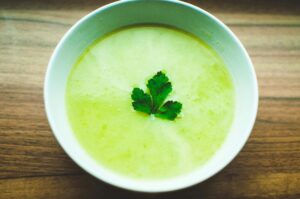
 This recipe is an adaptation of one I first made about 30 years ago (in my vegan days) from The American Vegetarian Cookbook from the Fit for Life Kitchen by Marilyn Diamond. Better hot but also good cold IMO!
There have been many incarnations of this soup in my life, including as a staple at the health food deli where I worked–along with a catering job–to finance an 8-week trip to an ashram in India (that, my friends, is a story for another time.)
Lately I’ve simplified the soup to the bare bones for a quick and delicious low allergen side dish. Sometimes I have this with a side of tempeh, sometimes chicken, and it’s a really great side with salmon.
(more…)

 Fact. You can’t fail at self-care.
 Fact. You can’t fail at self-care.
How many times have you decided that you’re going to make a change? Lose weight? Stop eating so much sugar? Read more? Avoid social media? Take your vitamins? Stretch regularly? Meditate?
If you’re like me and most of my patients and clients, it’s a number you couldn’t possibly begin to count. I remember when I was struggling with my weight and compulsively overeating. Every day I would wake up thinking today would be the day I would finally not fail. It would be the day that I would finally become the new me I’d always wanted to be.
When the day would end, and inevitably I found myself neck deep in a pint of ice cream or a bag of chips I would call myself out. I failed. Again.
Recently on Facebook one of my friends posted:
“I haven’t had a drink in 30 days. Not because I think I have a problem with alcohol but because I want to see how not drinking affects my sleep and joint achiness.
I also went super low carb (paleo keto) during that same time.
My fatigue (plagued me for years) is gone. I am never hungry. I’ve lost some weight. My mood and energy are stable throughout the entire day. In a nutshell, I feel amazing. Like really really REALLY amazing.
I went to an African drum dance class last night and had so much energy to dance it was unbelievable. I hadn’t eaten in 6 hours but because my body is fat adapted, I could power through with gusto.
Being an all or nothing type person, this has been relatively easy for me (giving up so many things). Now the trick is figuring out my balance. This is where I always fail and revert back to my gluttonous ways.
I want to be that 95 year old grandma jumping out of airplanes. Taking care of my health now has GOT to be a priority. This feels like a good start but I’ve been here before and failed…bigly (gained 60 lbs in under a couple of years).
Food and drink is an important part of my social life. I need to find that balance…lay your strategies on me…please!”
Facebook had plenty of answers for her. Here’s mine:
Oh Dear One, you didn’t fail.
You can’t fail at self-care.
Each and every step you take toward the you that you want to be is an important step. I’ve watched you over the last few years posting about your deeper acceptance of who you are independent of your weight. I’ve watched you over the last few years finding a wider voice that will help so many women. I’ve watched you embrace the quirky, off-beat, irreverent, and hilarious woman you are, despite a gaggle of difficult things in your life. If a 60 pound weight gain or another “failure” is what got you there, how, indeed, is it a failure?
It’s a success that you can see a vision of how you want to feel in your body. It’s a success to spend 30 days not drinking and following a paleo/keto diet (um…that’s a lot of work.) It’s a success that you are learning what your body craves and what it needs to keep you at the top of your game so you can have all of the energy you need to dance your ass off for hours on end.
Framing a weight gain after a weight loss (or picking up an old habit again) as a failure undermines your initial success and all the successes in between.
So no, you didn’t fail. You didn’t fail at all.
xo
And, as to your question, for me, it’s about getting clear about what’s most important. It appears that you have two conflicting values- socializing around food and drink, and feeling ah-maz-ing.
I would have you start with an important question:
What are your non-negotiables?
When I’m working with patients and clients I always work with them on three things before we decide what things are worth an all-or-nothing approach, and which things can be flexible.

- Values. What are your core values, who do you want to be in your life.
- Feelings. How do you want to feel on a day-to-day basis? This is mentally, emotionally, and spiritually.
- Health goals. What would vitality look like to you, and is this important? What would life be like if you felt the absolute best you could? And most importantly, what is the critical minimum for you regarding your health?
Once you are clear about these things (I am actually working on a virtual course to do this based on the Stress-Less Solution that I have been teaching for the last few years, keep an eye out) then you can identify your non-negotiables, that which is most important to do, or stick to. After all, you can only do so much.
After you get specific about these things you can then actually vet your choices based on that which is most important as opposed to based on how your brain chemicals are tracking. You can keep your brain from being overwhelmed by avoiding chronic decision-fatigue.
Now to the all-or-nothing issue.
Our brains crave dopamine. Social situations create this for us, but so does novelty and success. This is why a short-term program is easier to stick to than a long game lifestyle. If you know your priorities are in one direction and you have trouble with moderation, you could have dopamine to blame. Being aware of this can really help.
That said, when we use food, or alcohol, or social media for that matter to make dopamine because we are uncomfortable feeling feelings of discomfort that may be a “therapy issue” – a term I use with patients and clients for the need to understand and address how our pathology is driving us to make choices that don’t line up with our values. We all have these. The question is how badly are they undermining us and how willing are we to face them?
Food and alcohol are both sedating. They’re sensual. They’re soothing. They cause us to create dopamine. They are a socially acceptable way of numbing ourselves from the myriad things that are painful in our lives.
So no, going back to ‘gluttonous’ ways isn’t a failure, it’s a process of diving deeper into what it is that you really need and who it is you really want to be. That’s a success. The question is what are you going to do with it?
Yours in Health,


 Runny nose? Itchy eyes? Itchy skin? Fatigue? Sneezing? Cough? Asthma? Check, check, check! I always forget allergy season is coming until it hits, then GAH!!
I know I’m not alone, which is why I’m hosting another Facebook Live this coming Tuesday at 8am PT/11am ET to talk about allergies. I’ll be explaining what happens in your body when you get allergy symptoms, what supplements help with allergies, and when it may or may not be the time for a medication. And of course I’ll be answering any other questions you have.
 In the meantime, here are my top 5 lesser-known tips for dealing with allergy season:
 In the meantime, here are my top 5 lesser-known tips for dealing with allergy season:
1. Keep your face out of your dog. You may not be allergic to your dog or cat, but if they spend time out of doors during allergy season, they’ll be covered in pollen. You pet the dog then wipe your eyes? Pollen in your eyes. You snuggle your kitty on the couch? Pollen on your face. You see what I’m getting at here.
2. Rinse your sinuses. I hate the neti pot. I dislike the squeeze bottle irrigators. I use them anyway. Why? Because the inside of your nasal passages are covered with sticky stuff (aka snot) that pollen sticks to when you breathe in. Then it sits there, and your body reacts to it. If you rinse it out after you’ve been outside for a period of time your exposure goes down. Irrigation also washes away excess mucus. I’ll be discussing specific kinds of irrigators in the Facebook live on Tuesday.
3. No day-clothes on the bed. If you are out and about in your clothing and you get pollen on you, when you get in bed, the pollen will get on your bed. Now you’re sleeping with pollen. Not good.
4. Rinse your hair before bed. Same deal as #3 but worse because your hair collects pollen then it deposits on your pillow and directly onto your face/eyes.
5. Find out if you’re allergic to dust mites, mold, or your pets. Often doctors don’t bother testing for specific allergies if they occur during a particular season, because you’re not about to stay away from the outdoors as a rule. That said, if you have allergies to other things that are more in your control (for instance if you have dust mite allergies you can get a HEPA vacuum or dust mite covers for your pillowcases), you may be able to do decrease your overall allergy burden, making your allergies easier to manage.
If you have questions about any of this, or anything else about allergies, hit reply here and I’ll include them in the Facebook Live on my personal FB page this coming Tuesday, March 21st at 8am PT/11am ET. Remember, you can go back and watch these any time. You can find last week’s Live (How to choose a protein powder) here.
And of course if you want personalized recommendations, come on into the office in PDX or make an appointment to see me virtually. You don’t have to be resigned to taking medications or suffering through your symptoms.
Just imagine…a spring with less sneezing and itching. Heaven.
Yours in Health



Simple. Start from the beginning. Of course there are some kids that no matter what you give them they won’t have a taste for certain foods, but with the exception of kids with sensory issues, it’s the very rare exception that kids won’t eat a wide variety of foods if that’s what they’re used to. Adults who have an emphasis on nutrition in their own diets, and adults who are foodies or chefs most often have children who eat a wide range of foods including different kinds of vegetables (especially greens,) spices, whole grains, game meats, healthy fats, and even take herbs, fish oil, vitamins and other remedies without batting an eye. What’s so different about how we feed our kids? We give them a variety of foods from the start.
Call me a zealot but I say kids should get healthy and varied foods for as long as you can possibly manage it.
Children’s palates are a blank slate. They learn foods as they eat them. Now that said, some children do have an immediate dislike for certain textures or tastes. But even if your child rejects a food, try it again every few weeks, you’ll be surprised at how your child’s tastes change. I remember overhearing a mom say to a friend at the park “kids don’t like Chinese food.” The other mom said “What about Chinese kids?” Perfect.
A child who has never had white bread will be satisfied with whole grain. A child who hasn’t had food smothered in cheese won’t ask for mac and cheese for dinner. Oh, and by the way, dairy isn’t a nutrient, calcium is, vitamin D is, and your child will be fine if they don’t eat dairy on a regular basis for whatever reason, as long as they are getting enough calcium and vitamin D. But I digress.
Here are some tips to start your child off on the road to a diverse palate. And trust me, the earlier you start the better off you’ll be.
Generally avoid any food that is strictly sweet. Make sure there are other flavors: sour, bitter, salt, spicy, and umami. Example: Sweet potatoes? Add pureed chard, kale, and spinach. We actually added this to everything our son ate until he was off of pureed food. Oatmeal? Greens. Eggs? Greens. Chicken? Greens. All of it. Sometimes that and a bowl of greens. Not kidding.
Avoid the trap of “children need cake.” A mom actually said this to me when my son was under two. It sounds nuts but many (dare I say most?) parents feel it is depriving their children to not give them sugar when they’re little. It’s not. Now that doesn’t mean we can’t give kids sugar because there’s room for everything in a diverse diet, but truly they don’t need sugar and they don’t need to be taught that sugar = love.
Feed your child what you are eating (once they’re old enough) but that means YOU need to eat healthy food. Of course your child will eat pizza if you’re eating pizza. But a child raised on healthy food will also eat halibut with olive tapenade wrapped in organic prosciutto with a side of sautéed spinach.
Every meal can be served with a vegetable. Most meals with more than one. Including breakfast.
If you’re feeding packaged foods to your child, even from the health food store, read the label. If the food contains hydrogenated oil or corn syrup, see if you can find something without those things. If it has artificial colorings and flavorings, chemicals or preservatives, think twice. You want your child to be satisfied with the taste of real, whole food. Now that doesn’t mean that there is anything inherently terrible about processed food but while we are trying to train up taste buds, and while we do have control over what our kids do eat, that’s the time to pay more attention.
With every plate of food you prepare for your child (or yourself) ask yourself “Do I want to make this healthier?” And if the answer is yes, ask yourself how. And then do it. Only a few veggies? Add more. No protein? Add that. If a child starts with meals that are served with a hearty protein, several kinds of vegetables, some whole grain, and ideally at least a serving of greens, then that will become the norm.
Serve veggies first, when your child is hungry. We call it the appetizer. And although our son ate veggies with his meal when he was little, we got more in him when we started with a big bowl of some kind of veg while we’re getting dinner ready.
Add fresh herbs and spices to the foods you serve your child. From the beginning.
Breast feeding mamas- eat plenty of varied foods, especially those greens. If it causes your child digestive issues watch it but otherwise know that if you eat bitter veggies your child will more likely develop a taste for them.
If there is a food your child doesn’t like, mix it with something they do like to get them accustomed to it. Of course you don’t have to do this for everything…my son hated mushrooms when he was 2 and he hates them now at 18. He continues to make an effort to taste them a few times a year and now instead of gagging, he just says they make him “want to yak.”
Full disclosure I know this is a pain in the butt and you may very well not want to be ‘that parent’ but if you think nutrition is important, and you want your child to have a wide palate and enjoy all kinds of foods, trust me here, it’s worth it. You don’t have to get into a discussion about it with anyone if you don’t want to.
Yours in Health,

ETA: I read this post to my husband and he pointed out I should add that another healthy tip is to skip dessert as a regular part of meals. Just because you’re used to dessert, there is no reason to give it to children on a regular basis. Dinner can be complete, should be complete, without a sweet ending. How many adults wish they hadn’t developed that habit of wanting something sweet to eat at the end of a meal? Often when we have sweet we make it special and start the meal with it. We never wanted our kid to feel like he was eating just to get to something sweet.


 Every December, as the year winds to a close, I get a few dozen emails from patients and clients begging me to squeeze them in. It’s cold and flu season, no doubt, but most often that’s not what’s causing the emails and calls—it’s seasonal stress creeping up wreaking all kinds of havoc.
People are not only calling with typical stress symptoms like anxiety, depression, or sleeplessness, but with all the symptoms that are triggered by stress: IBS and digestive issues, headaches, rashes, inflammation, cravings, you name it. Whatever your weak spot is, wherever you tend to get symptoms, that’s what will flare up with stress.
And stress doesn’t only affect those of us who overdo it and make a big deal about the holidays, it affects most of us. There are so many things that can pile up at this time of year; the emotional aspect of wrapping up one year and starting the next, kids at home, travel, impending family ‘stuff,’ difficulty keeping on plan with food and exercise, financial worries of the season, and on and on.
If you’re one of the people who have more stress at this time of year I have some really good news. You can say NO!
Perhaps the worst thing about stress is that it so often feels like there is nothing we can do about it. Sure, we can meditate, breathe deeply, and practice mindfulness—these are good things to do. But even if we do those things often, we continue to have stresses pile up and eventually overflow because, simply, life happens.
But there is something you can do. If you think about it a little bit differently, you’ll see that you have much more control than you think!
Most people understand stress to be driven and impacted by factors we are familiar with from media, pop culture, and psychology. We think of large, life-changing events, such as a divorce, marriage, a sick family member, work or school pressures, a big move, or other events or circumstances that are out of our control.
The truth is that stress is more than just those big things. Stress is the entirety of the things that overwhelm us, the overall burden of the choices we make every single day about our food, our environment, who we choose to spend time with, where we spend our money, how we use our time, and many other things.
Of these myriad stressors, each one will fall into one of three categories
1. Things you cannot change.
2. Things you can change.
3. Things you choose not to change.
Most of us feel like our stress falls largely into the first category. The reality is that most of it falls into one of the last two. The trick to choose what you can and will change, right now, to get your overall load down.
Say no to the things that aren’t important to say yes to right now. Can you pick up a tree at a lot instead of driving an hour and a half to cut one down? Can you avoid sugar for the next few weeks so you have more energy for the extra things on your plate? Can you turn the TV off at 8 instead of getting stuck watching until 11?
Make no mistake, decreasing your overall stress load allows you freedom to breathe. It allows you more bandwidth to deal with the things you can’t change, and the things you’re choosing not to change.
 Be honest with yourself, and reasonable.
Think twice before you add something else to your plate.
Do what you can, and what’s important.
What are 2 things that you can say no to that will free up bandwidth for you to deal with the inevitable stresses of the season?
Hit reply and tell me what they are, I’d love to know!
Yours in Health,

PS. This photo of my boys is about 6 years old, I decided not to do a shoot for this blog post…one more thing off my plate! Man, do I miss those fat little cheeks!


As a first step in writing my book Overcoming Overwhelm—Dismantle your Stress from the Inside Out I ran an online stress survey. I had nearly 1400 responses, I wasn’t happy at all to see that so many of you are feeling stressed out, overwhelmed and tired, but I’m also holding onto the silver lining.

94% of you know that your stress levels impact your health.
This is an epidemic. But knowing and believing the stress impacts your health means there is space, even if it is small, to see and understand that you have control over your own health.
78% of respondents identified that “it feels overwhelming to do all the things I know I should do to take care of myself,” and just over half wouldn’t categorize their energy levels as excellent.
Of course, that leaves 22% of respondents who don’t feel overwhelmed and 45% who feel pretty good to excellent about their energy. This I’m happy to see!
For those of you who aren’t feeling optimal, you aren’t alone. Most of my patients and clients tell me their energy isn’t where they would like it to be. I think I can reasonably say it is one of the most common complaints people have about their health. And even when people don’t complain, most often they’re coffee drinkers (not judging, just noting). 🙂 Typically when I ask if their energy would be where they want it without the caffeine the answer is no. Ergo, their energy isn’t ideal. Coffee should be a yummy ritual, not a logistical necessity.
The association between stress and low energy is both causal and resultant.
When your stress is higher you feel more tired and overwhelmed, when you’re more tired and overwhelmed you have more stress. It’s a vicious cycle
The good news is that by identifying this problem you’ve already taken the first step towards better health.
More good news is that the second step, which often feels impossible, making changes or decreasing your stress is not only within your reach, but easier than you think. The key is that small changes—if they are the right ones—can make a profound difference in your health.
A few years ago I ran a 7-day energy infusion challenge where I sent out a tip a day for 7 days that people could implement immediately to increase their energy. Seeing the results of this survey reminded me about how helpful people thought it was so I’m putting the page back up for you to sign up if you’d like to check it out. After all, who can’t use a little more energy?! You can of course, as always, unsubscribe at any time.
Yours in Health,

Add more energy to your life every day.
Get 7 days of energy-infusing practices delivered to your inbox, FREE!
