
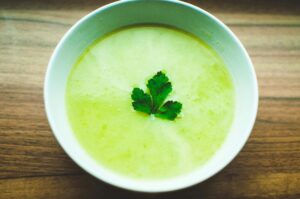
 This recipe is an adaptation of one I first made about 30 years ago (in my vegan days) from The American Vegetarian Cookbook from the Fit for Life Kitchen by Marilyn Diamond. Better hot but also good cold IMO!
There have been many incarnations of this soup in my life, including as a staple at the health food deli where I worked–along with a catering job–to finance an 8-week trip to an ashram in India (that, my friends, is a story for another time.)
Lately I’ve simplified the soup to the bare bones for a quick and delicious low allergen side dish. Sometimes I have this with a side of tempeh, sometimes chicken, and it’s a really great side with salmon.
(more…)

 I first stopped eating dairy when I was a sophomore in college. I had been a vegetarian for over a year at that point, but dairy was still a staple in my diet.
One day I was chatting with a friend about needing to make a little extra money and she suggested that I apply for a job at Mixed Nuts, our college food co-op.
These jobs were coveted and there were dozens of people who applied for each position (I never did figure out why) but somehow I made it through over half a dozen interviews and was invited to join the team.
Every week we would collate requests, place orders, and get deliveries of vegetables, grains, bread, legumes, nuts, and dairy products that we would dole out into boxes for members.
My first position was “bread manager.” One of the easier positions as the bread was already pre-packaged. If I put the order in correctly, it always worked out swimmingly. When my stint as bread manager finished up, I rotated into the position of “cheese manager.” Now this was another level of food management! I would spend hours cutting giant wheels or bricks of cheese and measuring them out for the individual boxes. Ordering, climate control, weighing, identifying, there was always a cheesy disaster waiting to happen.
I loved it despite the pressure because I loved cheese. I mean I really, really loved cheese. This led, of course, to “a bit” of tasting while I was parting out said cheese chunks. Within a few months of my new position, I was covered in a rash. When I realized it was the cheese I was apoplectic.
Cheese, after all, was my favorite food! What, I wondered, had I done in a past life that led to my body betraying me over my beloved cheese?!
 Over the following decade, I went back and forth eating and not eating dairy, for both ethical and health reasons. Around five years in I developed another symptom from eating dairy—a cough. It wasn’t until many years later I discovered was actually asthma. I now know that it is triggered by dust, cats, dogs, smoke, and yes…dairy.
Finally, after a particularly bad round of rash and cough, I decided it just wasn’t worth it. I quit for good.
There are many people over the years who have suggested to me that it’s important for all of us (including children) to drink milk and eat milk products. I can’t disagree with this enough. Of course calcium is an important nutrient, but there are absolutely no health reasons why humans would need milk, or any dairy for that matter, to get calcium. Now baby cows? That’s another story.
Dairy is not a nutrient. The FDA’s insistence that humans need to eat dairy is driven by the dairy lobby.
The dairy industry is $27 billion dollar industry—to producers. Do you think their lobby has a vested interest in trying to convince us all that dairy is an indispensable part of our diets? You bet they do.”Got Milk?” anyone?
That said, I’m not trying to vilify dairy. For many people dairy causes no symptoms at all and can be enjoyed in moderation. Though to be honest, I’m not convinced that 3-4 servings of dairy is necessary for anyone.
So when would you consider eliminating dairy from your diet?
Following is a list of some of the more common reasons:
Lactose intolerance. An inability to digest the sugar found in dairy products. Causes digestive distress.
Allergy. Including digestive symptoms, itching, hives, or anaphylaxis.
Sensitivity. Some common sensitivity symptoms include congestion, chronic sinus infections, acne, rashes, headaches or migraines, fatigue, and joint pain. It’s also a very common cause of constipation. I’ve seen more children than I can count put on stool softeners and laxatives from a young age because of chronic constipation due to dairy.
Increased phlegm. There are several studies showing that dairy intake does not cause increased phlegm but I can say with 100% certainty that it does for me and many of my patients and clients. And not only more, but thicker. Yuck.
Inflammation. There are also studies that show that dairy doesn’t increase generalized inflammation, or at least that it doesn’t raise typical inflammatory markers in the blood. That said, I have many patients and clients with inflammatory conditions (anything ending in ‘-itis’ and most autoimmune conditions) whose symptoms are clearly aggravated by it. There is one study showing that it increases inflammatory markers in the gut. There are other condition specific studies as well.
Ethics. Some people feel that it’s wrong to eat food that comes from animals in any way shape or form. Others just feel uncomfortable eating animal products when the animal has been treated poorly.
Concern about how milk is treated. The process of homogenization (so the cream doesn’t rise to the top) and pasteurization (heating to kill bacteria) may fundamentally impact how our bodies process milk. I’m not recommending raw milk as that would be a liability but if I were to drink milk personally, I would be much more likely to go this route.
Breast cancer risk. In pooled analysis from studies it appears that there is an association with high fat dairy products and pre-menopausal breast cancer. But, none of these studies looked at organic dairy, hormone free cows, range fed cows, or non-homogenized or non-pasteurized milk. Based on this and other design flaws I’m not sure I’d personally stop eating dairy for this reason.
If you have another reason, hit reply and email me back, I’ll update my blog post with those too!
If you avoid dairy, or have been wanting to cut it out, or even just cut down on the amount you’re eating, my next post will be a rundown of many of the current dairy alternatives on the market—with reviews!
Yours in Health,


My bedroom when I was a teenager.
For most of us when our space is organized and clean it’s easier to focus on the task at hand.
But we don’t often think about the flip side:
Clutter can drain your energy and significantly increase your sense of overwhelm.
In the last few years the ‘minimalist’ movement has hit the bookstore shelves and is all the rage in just about every blog and magazine.
The idea is that the less stuff you have the less of a burden it is to keep things clean…the less money you spend…the fewer decisions you have to make. I have several friends who have gone to a “capsule wardrobe” with only 30-40 pieces total. If you’re one of these people, more power to you (and…if that’s you, you can probably skip the rest of this post!)
Most of us, however, don’t want quite that much de-cluttering. I love the idea of only having a few things but it doesn’t really fit me or my lifestyle (at this point anyway.) I have, however, gotten rid of about half of my stuff over the last five years. It feels great. Where I used to buy things to make myself feel better, I now get rid of things. Don’t get me wrong, I still have way more things than I need. And I still sometimes buy things I don’t need, but it’s getting better. And I make more of an effort to keep things tidy.
One of the things that I help my patients and clients with is figuring out where they have control over stress in their lives and where they don’t.
Often our physical space is an area where we do have a great deal of personal control. Acting on this is empowering at the same time it is actually logistically helpful to keep ourselves on track.
Do you want to feel more settled? Less agitated? More focused? Do you want to look around and feel like your space is peaceful and sorted? De-clutter.
If the idea of organizing is daunting to you just take this one step at a time and be gentle with yourself, de-cluttering for most people is a difficult process. We get emotionally attached to our things and that’s normal. Be clear, though, about how it serves you to hold onto things vs. how it might feel once you’ve released things you no longer need. Remember that each step you take you’re choosing to make more space for how you really want to feel.
If this is something that feels like it would be helpful for you, I am going to suggest that you start with your bedroom. So many of my patients and clients report—after clearing out their bedrooms—that having a beautiful relaxing space where they sleep has literally improved their sleep quality. They also report that they wake up in a better mood when their sleeping space is spare, neat, and pleasing.
Clearing the Bedroom
- The space you sleep in should be clean, organized, and even a little Zen.
- You want the space to radiate rest and relaxation.
- A peaceful space to leads to more peaceful sleep.
Everything should have its own specific place. This may take some time to get in order but trust me, you’ll be relieved and better rested in the end.
1. Start with your bedside table. Clear the top. If you have a digital clock by your bed, move it across the room or get rid of it. It’s not good to have light or an electromagnetic field close to your head. If you can’t live without a clock at your bedside, get an analog alarm. I love the daylight alarm clock that slowly increases light, like sunrise in the morning. But again, not on your bedside table if you can help it.
The only things that should be on your bedside table (other than your analog clock) are any books you are currently reading (if you are in the middle of a number of books, pick two or three as this will prevent overwhelm), reading glasses if you use them, tissues, and a bedside lamp. If you journal before bed or when you first wake up then you can also have a journal and a pen. If your bedside table has a drawer, organize the contents and take out anything that you don’t use regularly or isn’t related directly to sleep or sex—the only two things you should use your bed for, according to sleep experts.
2. Dirty clothing. If you want to keep a hamper in your room, I recommend one with a lid. If you need a catch-all for clothes you take off before you sort clean vs dirty, or for when you’re in a rush, find a corner to tuck it into. This should be emptied daily, with laundry going in your laundry basket and clothing that you are going to wear again put into your drawers or closet. Dirty clothing is one of the worst clutter culprits.
3. The bed. Try to make your bed on a daily basis. Do this every morning as soon as you wake up. Coming into your room in the evening and finding your sleeping space neat and tidy will help you stay calm and centered.

Wall mounted jewelry armoire
4. Jewelry. I played with many systems to organize my jewelry and finally ended up with a wall mounted jewelry armoire. I have a large one that also doubles as my full length mirror, but there are smaller ones, as well as many different top of dresser or drawer systems to choose from. If you can use a storage system that is behind closed doors or in a drawer this will decrease the feeling of clutter in your space. If you don’t wear it, get rid of it.
5. Closet. If you have a closet in your bedroom, even though it’s behind closed doors it should still be organized. I recently read The Life Changing Magic of Tidying Up and the section on managing your clothes and closet was fabulous. I highly recommend it. What’s most important is that you must be brutal when organizing your closet to get rid of the clutter. This is an area that is very daunting for many people, which is why I left it for last. If this is hard for you, find a friend who also wants to tidy up and plan two dates—one at that person’s house, and one at yours! Make sure it’s a friend who will be blunt, honest, and loving.
If you’re not shooting for a ‘capsule wardrobe’ and you have the space, I personally think it’s fine to have lots of wonderful pieces. But only if each piece meets ALL of the following parameters:
1. Fits well and suits your body/figure (if you care about how your clothes fit)
2. Is in style or of classic style (if you care about style)
3. Isn’t falling apart
4. You love it (or like it a lot if it’s a staple piece…you don’t need to love your black cami or your gym socks)
5. You actually wear it
Once your bedroom is clear of clutter, make a plan for the next space- and put this on your calendar. One space a week, or one space a month, or whatever works for your schedule. You’ll be amazed at how this decreases your feeling of overwhelm, one little step at a time.
And on that note, my last patient didn’t show up so I’m going to go clear out some things from my office closet!
Yours In Health,
PS If you feel that you have a problem with collecting things such that it impedes your life or affects the people you live with, please speak with your physician about it. Hoarding disorder is a disease that can in many cases be treated with counseling or medication. Don’t carry shame about it. Get help if you need it. xo

 Any of you who have been around for a bit have been hearing and reading about my book proposal for a while. And when I say a while, it’s been over 2 years…for this book. There was another proposal before that which I decided to bail on at the last minute—but that’s another story.
The way that non-fiction books work, most often, is that you write a proposal in a very specific format and use that to try to get an agent to sell your book idea to a publisher. The format includes an overview of the book, about the author, a marketing plan including comps for books already published, a table of contents, chapter summaries, and a sample chapter. My proposal was 81 pages. It went out about a year ago to a handful of agents who my author friends and friends in publishing happened to know and recommend. I ended up deciding to work with an agent that two of my friends have worked with and really liked!
I’ll spare you the gory details of the process but suffice it to say, several iterations in, the book was picked up last month by Sounds True, my publishing house crush! I’m working on a final title with my editor over the next few weeks. The manuscript draft is due in the fall and the book should be hitting bookstore shelves in fall of 2018. I’m over the moon.
I cannot wait to share more about the details as they get fleshed out. The book is based on the Stress-less Solution class and content I’ve been teaching for the last few years, but with an emphasis on Overwhelm. I’ll be exploring the impact that overwhelm has on our health and stress levels and teaching a very specific plan for dismantling it.
A big thank you to all of my patients and clients who have been so supportive over the last few years as I’ve gotten this worked out.
Now, to write a book!
xo

 I don’t usually use my blog as a platform for very personal posts but today will be one of those exceptions. This is a piece I just published on Medium.
As the mother of a child who was born to another mother, Mother’s Day is more than just cards and flowers. My privilege is a profound loss for another woman.
So please, understand that on Mother’s day there are many women (and men) who might not be celebrating.
- Mothers who never got to see their child grow up.
- Women who want desperately to be mothers but for some reason didn’t end up doing so, or who are spending every last cent of their money to try to get pregnant right now.
- Women who regret not having children.
- Children who were adopted and will wonder forever where they come from. And their mothers who may have been forced, coerced, or bribed to place their children for a ‘better’ life. Perhaps even those who chose fully to place their children with another family.
- Mothers who are very difficult relationship with their children, or children who are in very difficult relationship with their mothers.
- Those whose mothers passed away too early- or after a long lovely life.
- Or any other reason that might not even occur to me.
Of course wishing a happy Mother’s day to all the Mamas everywhere is a lovely thought, but do keep in mind those who may be sad or triggered over this ‘holiday’…it can be a particularly difficult day.
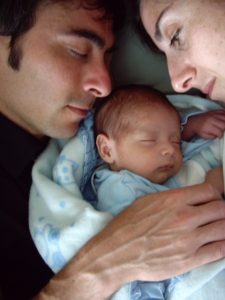
This photo is the first time we met our son in Guatemala. He came home ten years ago, on Mother’s day, my greatest gift, and perhaps someone else’s greatest loss.
With love,

 When my son was a baby we wanted to make sure that he was a vegetable lover. The way we went about this was extremely tactical. We mixed a slurry of kale, chard, spinach, and peas into all of his baby food. All of it. Pears? Half slurry. Sweet potato? Half slurry. Oatmeal? Half slurry. I wrote about that here, along with other tips on getting littles to eat their veggies.
As he got bigger we made, and continue to make, an effort to include at least 2 servings of vegetables with dinner. Often three. And snacks wherever we can. (Pro tip: one serving while dinner is getting prepared is an easy sell as there’s nothing more enticing to eat first.)
This recipe is super easy and loved by most everyone I’ve served them to, including my son’s friends who tell us they don’t like green beans (or vegetables in general for that matter!) So without further ado may I present:
Green Bean ‘French Fries’
What you need:
- 1 pound green beans (or asparagus if you’re a fan)
- 1.5 TBS olive oil
- 3 garlic cloves- crushed
- salt
- truffle salt (optional)
What you do:
- Preheat oven to 425°.
- Cut or pick off end of green beans, wash, and pat dry or leave out on a towel to air dry.
- Mix olive oil and crushed garlic in small bowl.
- Put green beans into a plastic bag (ziploc is easiest, a produce bag will work), pour in oil/garlic mixture, sprinkle with desired amount of salt (less salt if you plan on adding truffle salt, see #7), shake bag to coat beans.
- Arrange single layer on baking sheets and place in oven.
- Cook for appx 20 minutes or until the beans are slightly browned in areas, turning with spatula a few times during cooking. Remove at desired doneness—I like them a little crispy, my family likes them softer.)
- If desired sprinkle with a little bit of truffle salt for a gourmet touch.
Yours In Health,
Dr Samantha
Add more energy to your life every day.
Get 7 days of energy-infusing practices delivered to your inbox, FREE!
