
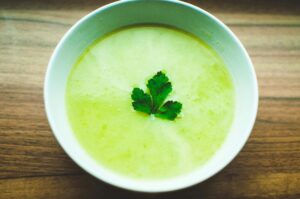
 This recipe is an adaptation of one I first made about 30 years ago (in my vegan days) from The American Vegetarian Cookbook from the Fit for Life Kitchen by Marilyn Diamond. Better hot but also good cold IMO!
There have been many incarnations of this soup in my life, including as a staple at the health food deli where I worked–along with a catering job–to finance an 8-week trip to an ashram in India (that, my friends, is a story for another time.)
Lately I’ve simplified the soup to the bare bones for a quick and delicious low allergen side dish. Sometimes I have this with a side of tempeh, sometimes chicken, and it’s a really great side with salmon.
(more…)

When I was dealing with some pretty bad anxiety a few years ago my yoga teacher gave me an assignment. She told me I had to put my “face in nature” every single day. Rain or shine. Anxious or not. It didn’t have to be for an hour, or even half an hour. Just ten minutes. If it’s raining, she said, grab an umbrella. If it’s snowing, put on snow pants. Whatever it takes.
It saved me.

More and more research is showing the benefits of getting yourself into nature.
In fact, getting into nature on a regular basis is one of the simplest things you can do to improve your health.
The first and perhaps the most important benefit of getting outside is sunlight exposure which allows you to get the vitamin D that your body needs. Adequate vitamin D intake is necessary for a properly functioning immune system, to build strong and healthy bones, for regulating blood sugar levels, and in regulating blood pressure. To learn more about vitamin D you can check out an earlier post here.
Being in the ocean or in contact with the Earth is another great way to get a benefit from nature.
The ocean is a large antioxidant; it contains free electrons which are absorbed into your body when you spend time in the water. These free electrons neutralize free radicals, molecules that can do damage on the cellular level. You may have heard of antioxidant supplements and antioxidants in food? When direct contact with the Ocean you also get antioxidants. For free!

But it gets better! Dirt and damp soil also contains free electrons—in a virtually limitless supply! So if you make time to be in direct contact with the Earth, your may see the benefits of antioxidants including improved sleep, blood oxygenation, heart rate variability, and an enhanced immune system while also reducing pain, anxiety, irritability, and inflammation.
If you cannot swim in an ocean and walking barefoot on the ground is not your thing, there are still many other benefits to being outdoors. Being in nature reduces stress, improves mental health, increase productivity, decreases exposure to air pollution, and has even been shown to reduce the symptoms of ADD and ADHD.
Several studies have shown that spending time in nature can improve sleep quality.
When we spend time in a natural setting we are, in essence, getting back to our roots. Our distant ancestors spent all of their time outside. As humans, we are meant to be in this type of natural setting. Our circadian rhythms, or biological clocks, work by synchronizing with day and night cycles. Our bodies function most effectively when we are in-tune with these day and night cycles. Our bodies use these cycles to regulate the release of hormones, in neurotransmitter production, digestion, and body temperature. By getting outside we are allowing our bodies to recalibrate.
It’s important, even in the winter to make sure you get outside! Even if it’s just a few minutes a day (the more the better!) you are likely to find that your anxiety will be decreased, you will ruminate less, your mood will improve, and if you have symptoms of seasonal depression, they will be reduced. There are so many beautiful green spaces around us, whether you live in Portland like I do, or in another part of the world. And if there isn’t one right around the corner, can you find a tiny patch of green or a park to visit at least here and there?
What can you do to find more time to spend in nature?
Yours in Health,


Most people eat more sugar than they think that they do. It’s everywhere. Go grab a few things from your pantry or your fridge. Spaghetti sauce. Crackers. Cereal. Yogurt. Even milk. Now, look at the label. Check out the serving size. Now, look at how much sugar is in that serving. 4.2 grams of sugar = 1 teaspoon. Now think about how this adds up. Even before you have anything that you think of as being a sweet treat…cookies, bars, etc.
But, but, but…what if it’s healthy sugar? Fruit? Raisins? Granola? Yogurt? Milk? Yes, those things have nutritional value so they’re better, of course, than a Snickers or a Ding Dong. But it’s still sugar. Make it count toward your health. Sweet potato. A piece of fruit. Some dark chocolate. A little milk in your tea.
When you eat too much sugar it’s straight up bad for your health.
Now to be clear I’m not saying sugar is evil. I don’t want to demonize any food. But here’s the deal: It can increase inflammation (conditions ending with –itis anyone?) Too much sugar in your blood can increase your cholesterol and triglycerides (for my high cholesterol patients I almost always suggest a high protein and low carb/sugar diet but that’s another post…) It can affect your heart health. It increases cancer growth. It can increase your risk for dementia. And that’s just part of the picture.
In short, for most of us, less sugar is better.
Here are my top tips if you think it would be helpful for you to cut it down (or out!):
- Read every label with the fact in mind that 4.2 grams of sugar = 1 teaspoon. If you’re reading this you’re old enough to choose what you’re putting in your own mouth. Eat sugar if you want but be conscious of it, and make sure that it’s something that you are choosing, not a knee-jerk reaction, and not because you don’t realize it.
- Eat enough food. More of my patients under eat than overeat. That includes people who come in looking to lose weight. If you don’t eat enough food you’ll be more likely to go off the rails and eat things that don’t line up with what makes you feel best.
- Eat more protein and good quality fat (nuts, seeds, avocado, olive oil, fish, coconut oil, lean meats etc.) Protein and fat stabilize blood sugar. Stable blood sugar means more stable moods so you’ll be less prone to go for sugar. Stable blood sugar means fewer sugar cravings.

- Sleep well. Studies show that you eat more when you don’t get enough sleep. Studies show that you are more likely to make poor food choices when you don’t get enough sleep. Studies even show that it’s harder to lose weight (if that happens to be something you’re after) if you don’t get enough sleep.
- Consider a sugar ‘detox.’ As a rule I really dislike the word detox. You don’t really ‘detox’ when you don’t eat sugar or carbs or whatever other thing you’re not eating. (Also, please don’t take laxatives for a ‘detox’ that’s not a detox, but I digress.) Because sugar can literally be addicting to the brain, sometimes it’s best to just STOP to be able to get off of the sugar merry-go-round. We get accustomed to the taste of sugar such that we need more and more to get both our taste and emotional needs met. When you stop eating it for a while (and I do recommend all sugar if you can manage it, natural sugars included) your taste will literally change.
- Avoid artificial sweeteners. First, we really have no idea how these affect our bodies in the long game. Studies seem to show that they actually cause weight gain (again, only an issue for those who have concern about this.) But also, when you eat sweet things your tongue will want more sweet things. I also believe that our bodies are designed to ingest food the way nature made it. As one of my colleagues says “Eat close to the Earth.”
- Look at what is underneath your sugar consumption. No, your body doesn’t need chocolate when you lack magnesium. And no your body doesn’t need sugar when you’re tired. Cravings are almost always emotional. Sugar makes us feel good. It is often offered as a substitute for love, as a reward, and as a way to make ourselves feel better. Of course, it’s ok to connect around food but not if it feels like it’s ruling your life, or if it’s affecting your health. If that’s the case then you need to look at what is driving your sugar consumption. The more you understand, the better choices you’ll make.
- Find another dopamine booster. See my last post about dopamine and sugar. If you have other (legal and ethical of course) ways to create dopamine then you’ll be able to meet that part of why you feel driven to eat sugar in another way. Novelty, sex, companionship, and exercise are all options.
- Supplements. There are two supplements that I will often recommend to patients and clients who are dealing with sugar cravings are l-glutamine and chromium picolinate. Of course, you should talk to your own physician about whether it’s appropriate for you—and if you need some personalized guidance about what might be best for you from a health or nutritional standpoint, you can book with me personally here. 🙂
- Purge your house. If there is food that you legitimately don’t want to eat, get it out of your house. Don’t finish it. Donate it. That half eaten pint of Ben & Jerry’s? It won’t do you any more good in your belly than it will in the compost if you really are trying to cut back. If you have kids that ‘need’ junk food in the house, consider whether that is actually true. Does your eight-year-old have to have a cookie for dessert? Could she have a piece of fruit? Is it necessary to have family dessert every night?
- Ask yourself what’s most important…every, single, day. My book Overcoming Overwhelm—Dismantle Your Stress from the Inside Out guides you through a process of identifying what is most important, as well as how you want to feel in your body and how you want to feel emotionally. Think about this before you grab that muffin. Is this the best choice you can make? What other options do you have? If it is your only option, how can you plan better for tomorrow? Bring nuts with you to work. Keep jerky in the car. Make this smoothie instead of the one that you usually make with all that fruit.
- Be kind to yourself. Nothing will make you binge on sugar faster than hating on yourself for eating that cookie when you decided you weren’t going to eat a cookie. Judging your body, judging your own choices, judging yourself in any and all ways is a sure fire way to lead you down a road of self-destruction be it major or minor. If you don’t believe with every cell of your body that you deserve to feel good, make it a priority to do your work to figure out why you don’t.


A healthy, life is waiting for you—body, mind, and spirit.
Go get it!
Yours in Health,



 Have you ever wondered why you can’t just eat one cookie at a time? Or why diets are so difficult to sustain? Or why you’re thinking about cookies right now instead of the words you are reading? It’s sugar, sugar!
We evolved to seek out sugar.
Our brains are hard-wired to make us love sweets. This was an absolutely crucial evolutionary adaptation when food was scarce. Our ancestors may have gone days or even weeks without food, so when they came upon a sweet, high calorie food, they made sure they ate as much as they could of it. This prevented our ancestors from starving.
High caloric foods would provide for the function of the day and then the body stores any leftover sugar in the liver (as glycogen) so that there was energy available to run away from an angry wild pig. And when there was an abundance of sugar, or more than could be used for the day or stored as glycogen, the body stored it as fat. These fat stores could be pulled on in times of famine, which were a lot more frequent than they are today. These fat stores kept our ancestors alive.
The problem we run in to now is that sugar is not only readily available but it’s in just about every processed food we eat!
It’s even in things that we consider healthy—cereal, protein bars, yogurt, bread, and most spaghetti sauce!
When we consume sugar, the brain’s pleasure center (nucleus accumbens), receives a dopamine signal. The increase in dopamine—a neurotransmitter, or brain chemical, provides an experience of pleasure. Again, this was great for our ancestors who ate relatively little of it but when we have sugar in so many of the things we eat, processed or not, it can cause more harm than good.

And to add insult to injury, when we consume sugar for an extended period of time, the amount of sugar required to get that initial feeling of pleasure from the dopamine signal increases; thus, we need to eat more and more sugar to get the same pleasurable experience.
And for many of us, when we stop eating sweet things there is a period of withdrawal – causing feelings of discomfort, both physical and emotional. To get back to feeling normal we consume sugar. It is a vicious cycle. This is the same cycle in addiction to drugs such as cocaine and heroin—although whether sugar is addictive or not is a matter of intense debate in many research circles.
Additionally, chronic overconsumption can cause the dysregulation of a hormone called leptin. Leptin helps in signaling feelings of satiety. So, when leptin is not working properly, food cravings can result.
There are often emotional aspects of sugar addiction as well.
Eating sugar makes us feel good, which can override pain, anger, sadness, fear, or any number of other uncomfortable emotions. Is that a bad thing? Food and sugar are generally acceptable ways to suppress our discomfort so ultimately you need to decide if it’s ok for you. My own experience was pretty intense around sugar addiction. I would binge on it regularly. So much so that it impacted my quality of life, my energy, my health. I thought about food constantly. It was exhausting.
At some point I simply had enough. I decided that I no longer was willing to let food, specifically sugar, rule my brain and my life. I did gobsmacks of counseling to figure out why I was using food in the way that I was, and ultimately cut out sugar entirely for years before I finally freed myself.
Cutting down on sugar is easier said than done. But, it is possible!
If you need to do counseling to really figure out what is behind the emotional part of your consumption of sweet foods, do it. You won’t regret it. As for the physiological part, eating a balanced diet high in fiber, healthy fats, and protein can really help with satiety and cravings for sugar. Avoid sweet things as much as you can as they will act as triggers for most of us. This means avoiding fake sweeteners as well as real sugar. It means more veggies and less fruit. It means reading labels and keeping both added and natural sugar of all sorts to a minimum. And did I mention protein? Lots and lots of protein.
 The first step for most people is to take a hard look at how much sugar they are actually eating. 4.2 grams of sugar = 1 teaspoon. Think about that—and look it up the next time you go for a pumpkin spice latte at Starbucks, or even a teriyaki dish at PF Chang’s. You can find the nutritional information for just about anything by looking at a label or searching google (the magic of the interwebs!)
Here is a chart from my book: Overcoming Overwhelm: Dismantle Your Stress from the Inside Out with some examples of how much sugar you might find in some common foods.
- Nancy’s nonfat vanilla yogurt = 7.5 tsp of sugar
- Kirkland signature trail mix 2 oz = 5 tsp of sugar
- Starbucks grande nonfat no whip pumpkin spice latte = 12 tsp of sugar
- Starbucks grande nonfat green tea latte = 8 tsp of sugar
- Rx blueberry protein bar = 4 tsp of sugar
- Dunkin Donuts bran muffin = 9 tsp of sugar
Everyone has a different journey around sugar but if you struggle with this remember that you are hard-wired for it. I do not think we should be ashamed of our genetics and the adaptions that have made our lives possible today, but I do believe we have the choice to eat healthily and live the fulfilling, vibrant lives that we desire and deserve.
Now put down that cookie and go get an avocado!
Yours in Health,

If you want to stay healthy through the winter and beyond, don’t forget your vitamin D!

Where I live in Portland, OR, we’ve had an abundance of sunshine-filled days this winter- a rare treat! But no matter the season we need to be attentive to how much vitamin D we get. I’ve talked about winter blues in a past blog post but the blues aren’t the only issue we face with shorter, darker days. We also face lack of vitamin D, aka, the “sunshine vitamin.”
This vitamin plays an important role in making your bones strong, helping your immune system to work properly, and it even controls the expression of over one-thousand genes in your body! It prevents bone loss, and studies even show it can help prevent cancer, diabetes and cardiovascular disease.
The most direct way to get the D you need is through sun exposure.
The body is incredible in that it can take the UVB radiation from the sun and convert it directly to usable vitamin D! But in most places the winter the sun does not come out enough for this to be possible. And, if you’re lucky enough to live in a sunny place, if you wear sunblock…no vitamin D. And it’s also important to know that the darker your skin the less vitamin D you absorb. In short, for many people, if not most, it’s difficult to get enough sun to get enough vitamin D.
There are food sources that have small amounts, including fatty fish, egg yolk, beef liver, cheese (if you eat dairy), and sun-exposed mushrooms. Unless you eat a lot of these foods though, it’s unlikely that you will be getting enough vitamin D.
This is where supplementation comes in. The best way to ensure you have adequate vitamin D levels is to take a vitamin D3 supplement. Vitamin D2 supplements are available, and most often prescribed by MDs, but vitamin D3 is most effective at raising blood levels. D3 supplements are typically derived from animals and D2 are plant-derived, although there are now vitamin D3 supplements derived from lichen, a vegan-friendly source!
Before you buy a D3 supplement it is important to first get your blood levels tested.
Testing will help you determine if you are deficient, within normal limits, or have too much vitamin D. For vitamin D, there is an ideal blood level which you should have tested with a trained physician or nutritionist who understands about the importance of vitamin D and the difference between D2 and D3.

- Under 30 ng/mL = deficient
- 30 ng/mL – 40 ng/mL adequate but not ieal
- 40 ng/mL – 70 ng/mL ideal (for most people)
- 70 ng/mL – 100 ng/mL = possibly too high
- Over 100 ng/mL = top of acceptable range.
Vitamin D is a fat-soluble vitamin, which means it can build up in your system, so it is important not to overdo the supplementation. Generally, supplementing with 1000-4000 IUs per day is considered safe. I will often use higher doses with patients based on their individual needs.
Your practitioner should do follow up tests until you know that your your level is within the ideal range and that you are on the right amount to maintain it. This is truly the only way to be sure of the proper supplementation dose.
You need vitamin D for healthy bones!
There is another very important thing to consider with vitamin D—it has a direct effect on the amount of calcium you absorb from the foods that you eat. When you have a vitamin D deficiency, you may only absorb 10-15% of dietary calcium. With adequate levels, you absorb about 40% of your calcium. It’s a big difference! You need the that calcium for your bones, and you don’t want it milling about in your blood it can build up over time causing blockage of blood vessels increasing your risk of both stroke and heart attack.

A quick note on that calcium. In order to make sure it doesn’t build up in your vessels it’s best to take the right form of calcium (if you’re taking it)—I recommend calcium citrate, and enough K2 to activate the carrier proteins that shuttle calcium into your bones. You can get that in a supplement made from natto, a kind of fermented soybean. You can also eat it (natto) but it’s a bit of an acquired taste to say the least (as in…you couldn’t pay me to eat it.)
Now go get some sun on that pretty face!
Yours in Health,

Are you looking for vegan dairy alternatives that actually taste good?

My last blog post was about why you might want to avoid dairy. If you haven’t considered this, go take a peek at that post before you dive in here!
I originally wrote a post in 2011 titled Is it Real or is it Memorex about how to find decent vegan dairy alternatives. At that time I brought up the fact that finding dairy alternatives was soooo much easier than it had been when I initially became vegan in the early 1990s. At that time the only options were soymilk (blech!) and fake cheese—also made of soy—that had casein, a dairy protein, in it.
This is an updated and more comprehensive post on dairy substitutes.
Many of the products I mentioned in 2011 aren’t available anymore. There is good reason for that—there has been more demand for dairy-free products that taste good so companies have been developing better and better options. What seemed so great in 2011 was, in retrospect, just ‘meh.’
This post will list some of my current favorites and a few of of my not-so-favorites.
Please note there are many local companies in other parts of the country that I don’t know about so be sure to take a look at what other brands you have at your local health food store.
One word of warning before we dive in, taken from my original post that still holds true to this day:
“When my son was two and a half he saw a picture of a mastodon in a book. He said “Dat’s not a elephant, but it’s similuh.” Right. Similar. Not the same. So think of that when you’re trying to replace dairy. If you don’t expect an elephant to be the same as a mastodon you won’t be disappointed.” -me
Milk:
First I’ll start by saying I don’t recommend soy milk. It can have hormonal-like effects, it is difficult to digest, and for many people it creates phlegm in the same way that dairy does. I’m especially concerned about soy milk for kids. Just, no.
When choosing a milk substitute you’ll want to know first whether you prefer a thicker, heavier type of faux-milk that has a mouth feel like whole milk, a thinner more watery type of faux-milk that has a mouth feel like skim, or something in between. Expect to try a few kinds and brands before you settle on one or two you love. Hemp and coconut milk tend to be thicker, almond and rice, thinner. But brand can really make a difference.
Next, you’ll want to know whether you’re looking for something more or less sweet. I always recommend getting unsweetened as most of us can do to decrease our sugar intake and I would rather have people eat their sugar in the form of fruit (or chocolate!) Cow milk has quite a bit of natural sugar in it so we get used to milk being a bit sweet. You’ll get used to the unsweetened pretty quickly though, especially if you’re drinking a glass straight up, you won’t even notice.
My favorites:
- Pacific unsweetened vanilla hemp milk or unsweetened almond milk. Please note most of the hemp milk brands taste like, well, what you would expect them to taste like, and not in a good way. Pacific doesn’t have this issue.
- Califa almond or almond/coconut.
- Good Karma flax milk (there is one with added pea protein if you don’t mind the taste!)
- Make your own. You can find recipes for nut milk all over the interwebs. It’s pretty easy to do, and saves money!
Cheese:
I think about vegan faux cheese in three categories—slices for sandwiches or snacks, shreds for melting, and gourmet for eating with crackers or some such.
- Slices hands down Follow your Heart mozzarella or provolone slices. They are both great on sandwiches. I don’t recommend melting it though.
- For melting Daiya mozzarella shreds are my favorite. Go easy though, too much becomes texturally problematic. I make a mean GF mac & cheese with this stuff, lmk if you want me to post the recipe!
- Mikayos is more of a gourmet type ‘cheese’ that you would slice to eat with crackers or veggies. The smoked farmhouse and the ash are my favorites. They have a soft mozzarella type that I didn’t love.
- Also a gourmet type that is spreadable is called Treeline. I love the chipotle serrano pepper one on GF Mary’s Gone Crackers. Sooo yummy.
- Ricotta is another cheese I missed for a long time so I came up with a decent recipe to use instead, you can find it on this post for GF/DF eggplant parm. Kite Hill also makes a ricotta cheese sub that’s very good. I love it with grated raw beets and toasted walnuts
Creamer:
Please note many of the vegan creamers are full of sugar. Here,again, I recommend using unsweetened so you can use less sugar and continue to cut it down over time (assuming you want less sugar…hmmmm, maybe a blog post on that is in order.)
- By far my favorite brand of creamer is Nutpods.It’s thick and doesn’t curdle in hot liquids. Unsweetened, of course. There are flavors as well as plain, which I don’t prefer, but you might! It’s made from almonds and coconuts. I don’t love the flavor of coconut so will note that this is very subtle in Nutpods which is the reason I prefer it over my second choice, below.
- My second favorite is Califa. The sweetened version has a lot of sugar so I will steer you away from that on principle. If you don’t care about that you’ll find it is most like the sweetened commercial creamers most people are accustomed to using. It does have a coconut taste to it.
- Another brand that people love is the So Delicious coconut creamer. Clearly, I’m not a giant fan of coconut so the Califa one is a little less intense as it’s mixed with almond.
Cream Cheese:
- Tofutti brand has been around for a long time and tastes great but it’s soy, which as you know I don’t prefer. If you do get this, make sure that you get the non-hydrogenated (yellow container.)
- There is a new brand called Kite Hill that is amazingly delish and tastes remarkably like real cream cheese. It’s made from cultured almonds. There is a plain and a scallion version. If you can get this one, I would recommend it over the tofutti for sure.
Sour Cream:
I don’t really like any of the sour cream options out there. Well, the Tofutti one tastes good but you know by now how I feel about that. Of late I’ve been using Foragers unsweetened cashewgurt (cute, right?) for sour cream. It fits the bill taste wise but it is pretty thin. I am planning on doing some experimenting with thickeners to see if I can work on that. I’ll keep you posted!
Ice Cream:
In 1912 when I was first vegan (ok, 1990) there were really no creamy ice cream alternatives. My sister showed me how to take rice dream ice cream and mash in hazelnut butter (it would work with any very creamy nut butter.) It made an icy, overly sweet, poor excuse for ice cream and turned it into something that was actually edible. Not great. Edible.
Now there are many really good brands. I particularly like the coconut based options as they tend to be fattier like ice-cream. My mom used to get us “ice-milk” when I was a kid (gag) so I don’t really like the less fatty options. 🙂
- Coconut ice cream: Coconut Bliss, Larry and Lunas
- Nut based ice cream. There are lots of local brands here in Oregon, and a few national brands- mostly cashew based. They’re good. A little too sweet for my taste but decent.
- Ben & Jerry’s. I just bought this for the first time this weekend. Oh my goodness, it’s amazing! It does have corn syrup so it’s not the healthiest option but for here and there? Do it!
OR make your own! This is the best way to manage how much sugar you’re getting and you can use real fruit instead of sugar. It can be done in an ice cream maker (google ‘paleo ice cream’ for recipes) or just in a powerful blender like a vitamix or a ninja. My ten year old is equally happy with this as he is with a vegan treat from the local fro-yo place. This is my favorite
• ½ frozen banana
• 10 ice cubes
• 2 TBSP peanut or almond butter
• 2 heaping TBSP of hydrolyzed collagen protein
• 3 TBSP or more of unsweetened vanilla pacific brand hemp milk to preferred texture
• you can also add spinach!
if this isn’t sweet enough you can start with more banana and as you train yourself to the less sweet taste (assuming you want to do that!) you can start cutting it back
Yogurt:
I can’t talk about brands of yogurt before I remind you that flavored yogurt, dairy or not, is pretty much pudding (dear me, I am on my sugar soap box today…sorry!) I have patients tell me they eat flavored yogurt every day to get probiotics. I say if you need probiotics take probiotics, or make water kefir. Most vegan flavored yogurt has 4-5 tsp of sugar per small container.
- Kite Hill plain. This has 1 tsp of sugar per small container. There is an unsweetened version but it’s pretty much unpalatable. I bet it would be fine in recipes though.
Foragers cashewgurt is my favorite right now- I’m using it in recipes and with fresh fruit as a snack (I’m also adding hydrolyzed collagen protein to boost that a bit.) - Coconut yogurt is another option. There are lots of brands now, I don’t love any of them.
- There are other types and brands of non-dairy yogurt but all of them are the sugar-laden type that I just can’t get behind. Most of them also have a weird mouth feel.
Butter:
Soy free Earth balance (in the red tub or box) is my favorite dairy alternative for spreading or baking. I also sometimes sub with coconut oil or even olive oil for lower heat circumstances.
That’s just the tip of the iceberg. Sooo many great options available!
Yours in Health,

Add more energy to your life every day.
Get 7 days of energy-infusing practices delivered to your inbox, FREE!
